
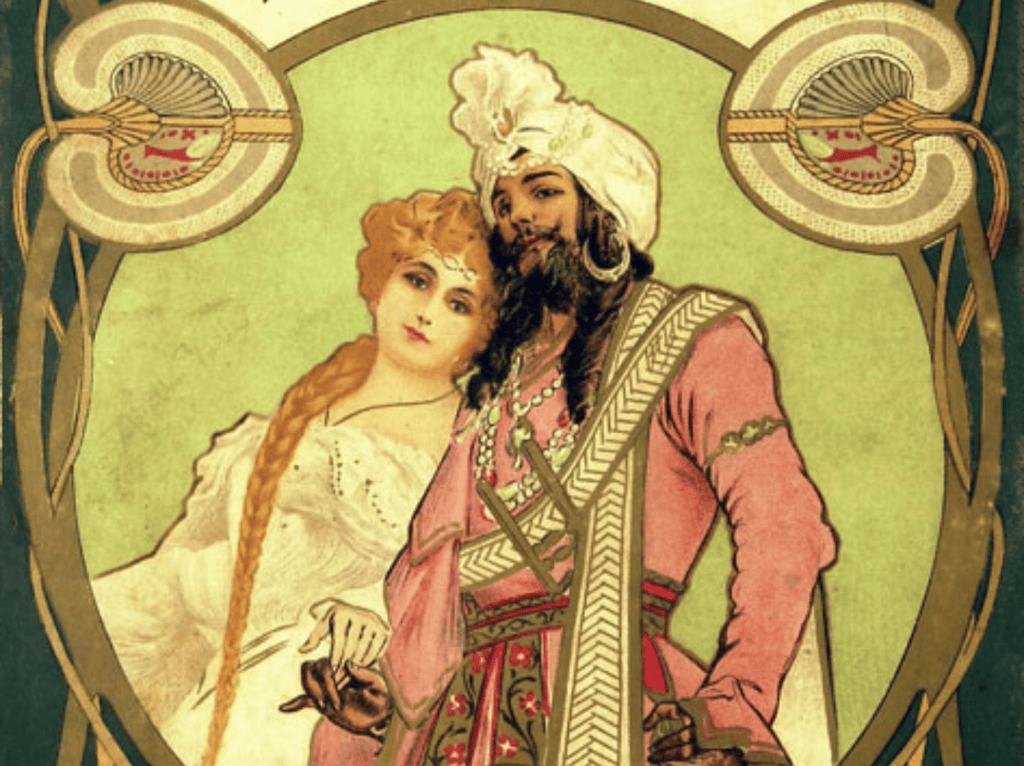
I’m a sucker for a good Pulp adventure story — there’s a reason why Robert E. Howard is one of my great literary idols.
Honestly, I’m more at home reading stuff from decades or even centuries — or even millennia ago — than most recent books.

Translation of the Epic of Gilgamesh by A.R. George et al, via the Ludwig Maximilian University of Munich’s Electronic Babylonian Library Project.
Photo by Bilge u015eeyma Ku00fctu00fckou011flu on Pexels.com
Obligatory shout out to Carleton University’s College of the Humanities.
I’m going somewhere with this, I promise…
Pirates are a fairly common literary subject, especially in the Pulps: Captain Blood, The Sea Hawk, Treasure Island, The Long Ships (for a certain value of “pirate”, at least), a major subplot of The Count of Monte Cristo, if not the entire thing. And, incidentally, the bulk of those have also got pulpy movie adaptations
Until fairly recently, the most popular literary pirate I’d never heard of is probably Sandokan.
Now, the reason I hadn’t heard of Sandokan until recently may have to do with the fact that, despite the original novels being written between the 1890s and the 1910s, they were only published in English in 2008 for the first time.
Despite the lack of awareness in the English-speaking world, Sandokan has actually been hugely popular and quite influential in other parts of the world, inspiring several films — done with primarily Italian casts and crews (the original novels themselves being Italian and apparently still quite popular in Italy) – a series of TV, um, series (also Italian), a Spanish cartoon where everyone is animals that aired on various stations in Europe, and even a Mexican wrestler.
Notably – and perhaps unfortunately, despite being a Bornean Dayak in the stories, all of the actors who have played him so far have been American, Italian, or Indian – and, most recently, Turkish. In researching this post, I’ve seen a fair few comments lamenting that Sandokan has never been played by someone who is actually Southeast Asian, despite the importance of Sandokan being both Southeast Asian and fighting against European colonialism in the region to the story.
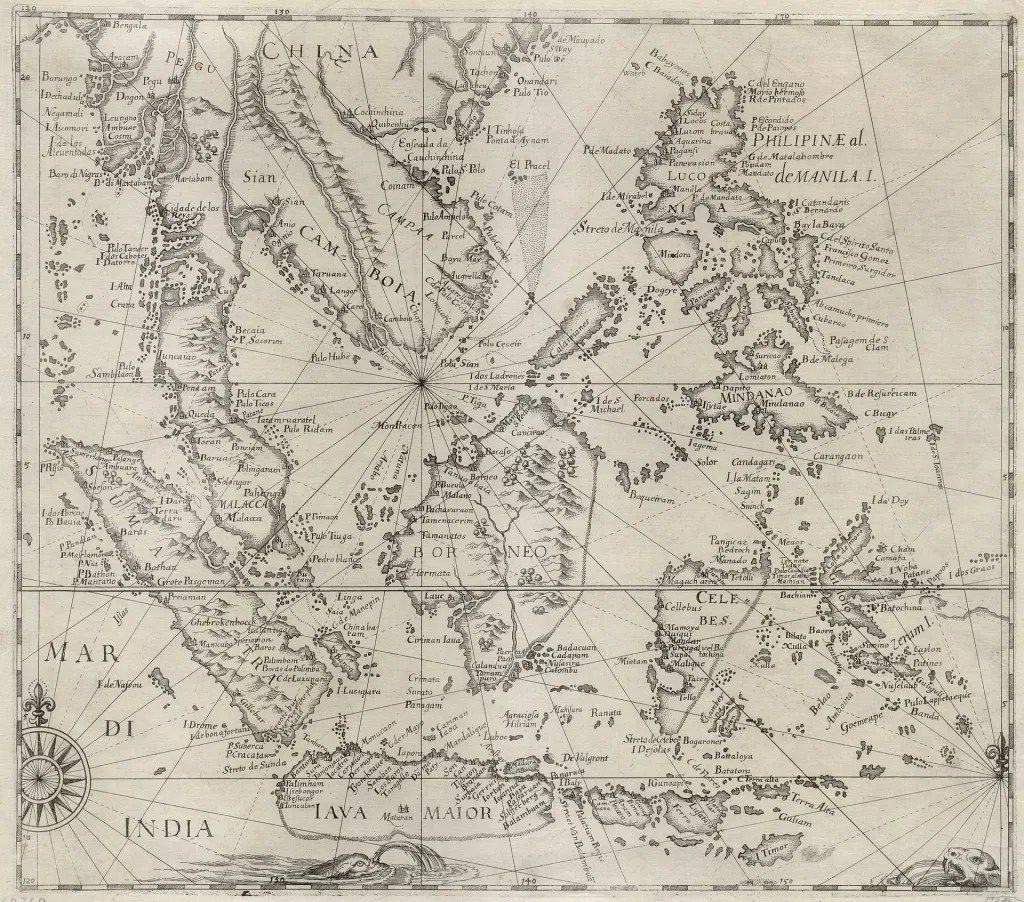
Map by Theodore De Bry, via the Singapore National Library Board. Public Domain.
On that note, despite being written a few years on either side of the year 1900, the Sandokan novels portray the European colonial project in Southeast Asia as unequivocally negative. Sandokan and his overwhelmingly non-white pirates are the protagonists — though, of course, as pirates, they are exactly nice people — whereas the British, Dutch, and Portuguese Empires are very much the bad guys.
Of course, “colonialism is bad” is pretty much the consensus in 2026, but keep in mind that most of the colonial empires still existed in the early 20th century and plenty of Europeans were still fully supportive of the colonial project.
Rudyard Kipling was three years younger than Sandokan author Emilio Salgari. While indeed a prolific author, what is most relevant to the point I’m trying to make here is that Kipling was a big proponent of the idea of the White Man’s Burden to civilise the rest of the world – I don’t know if Kipling coined the phrase, but he literally did write the book, or at least a poem, on it.
All of which is to say, that while Salgari’s depiction of colonialism as a negative force and indigenous resistance to the colonial enterprise as a heroic effort probably resonants with audiences now, he was absolutely writing at a time where Europeans in general were all-in on the colonial project.
Sandokan himself is established as a famous pirate from the get-go in the books, known as the Tiger of Malaysia and his crew knew as the Tigers of Mompracem, an old name for the island of Kuraman. That’s also the name of the first book in the series.
Notably – and accurate to real-life pirates – Sandokan’s crew is multiethnic and diverse, primarily made up of members from East and Southeast Asia (not exactly surprising given the setting), with his second-in-command and best friend Yanez being a Portuguese, specifically from the colony in Goa. Yanez is the one white member of the crew, but is essentially Sandokan’s blood brother. And by virtue of being the older the two, he can get away with calling Sandokan “little brother.” Although Yanez being the smart one does often save the day, this is portrayed less as Yanez have some kind of superior European intellect and more that he is simply a shrewd and intelligent individual.
Also noteworthy in the cast is Marianna, Sandokan’s Anglo-Italian love interest, the niece of a British colonial figure on Labuan and an antagonist of Sandokan’s. Having been raised by her uncle, including accompanying him as a child on his expedition against the local pirates, she has rather more military experience than the typical Victorian lady…
Sandokan himself is portrayed a bit like Conan, or least Conan as depicted in the original stories: not necessarily well-educated, but shrewd and crafty, though primarily a fighter and a frontline leader. Notably, Sandokan is sensible enough despite his own physical prowess to realise when the pirates need a plan beyond “Attack the Bad Guys” and will defer to Yanez in his capacity as the Brains.
Incidentally, Conan has also been a pirate in several stories. And, in fact, one of the most famous Conan stories focuses on his time as a pirate and his relationship with a famous pirate queen.
I had the same issue reading the Sandokan stories as I did reading The Witcher. Namely, that I found the prose pretty stilted and blandly sort of “This happened. Then this happened.” Now, as I don’t read either Italian or Polish, I can’t say how much of that is present in the original prose and how much is because of the translation.
And it’s probably also at least partly something of an aversion to simpler prose on my end due to most enjoying flowery, deliberately archaic stuff like Tolkien, Howard, and Gene Wolfe.
Even so, Sandokan is still a interesting series for a number of reasons. Sandokan is a badass, Yanez is a different kind of badass, and there is some cool stuff happening on the page – just described more plainly than perhaps I would lie.
It’s also a fascinating time capsule of Turn-of-the-Century adventure novels, though that does include some attitudes about gender and race that haven’t aged well. On the other hand, Emilio Salgari’s is also shockingly progressive for the period and comes across as notably less problematic (which, in hindsight, doesn’t really sound like a compliment) than other authors from later in the first half of the twentieth century — again, Robert E. Howard is one of my literary idols, but I’d never look to him for insight on women or non-white people.
Or, honestly, anything other than the best way to succeed at fighting evil wizards or bareknuckle boxing, really…
Since I wrote the original version of this post a few years ago, there has been yet another show adaptation of Sandokan. Specifically, a 2025 series from RAI, the Italian national broadcaster.
My big takeaway is that Sandokan has some absolutely awesome theme music whenever he’s doing something cool.
It’s sort of equal parts an adaptation of Tigers of Mompracem and an original story. Admittedly, I didn’t remember that many of the details from the original by the time I watched it, but I feel like it plays fast and loose with some of the source material: Sandokan meets his mom in one episode, but I’m pretty sure that – like Batman, his parents are deeaaaaaaad! – in the books. Yanez has a tragic backstory that I don’t remember in the books, being a former priest who’s been grappling with a crisis of faith since the Indigenous Paraguayan community he was the pastor of was massacred by what I believe are supposed to be anti-Catholic government forces, but I don’t have a solid enough grasp of what was going on in Paraguay in 1825 to know for sure. There’s a character based on Emilio Salgari himself taking down notes as things happen.
And there’s a character played by John Hannah – probably best known as Jonathan from the Brendan Frazer Mummy movies, and perhaps to Canadian audiences as the chief of the emergency department on Transplant – that I do not remember being in the books. He’s sort of a loyal but conflicted British soldier who’s sent after Sandokan and starts to get really disillusioned with the whole thing as he realises that Sandokan is a pretty cool dude and being a cog in the colonial machine sucks.
It’s low-budget compared to an American show or a British period drama, but it never feels cheap. It’s not as completely off-the-wall as Pirate of the Caribbean but never takes itself too seriously.
In fact, I stumbled onto this Instagram video that I think sums everything up nicely:
The Sandokan novels are published in English by ROH Press. The 2025 series Sandokan: The Pirate Prince is streaming (in Canada) on Netflix.
Now, a quick reminder that I am a professional writer and editor, and if you’re in need of writing and editing support, please consider taking a look at the work and rates currently offered by Emona Literary Services™ and reach out if you think I can help you.
Please consider supporting Emona Literary Services™ to help me expanding my publishing and content creation projects, via Patreon, Ko-fi, or directly through Paypal by scanning the QR code below:

You can follow me on my various social media platforms here:
© Joel Balkovec — Published by Emona Literary Services™.

This work is licensed under a Creative Commons Attribution-NonCommercial-NoDerivatives 4.0 International License.
The author prohibits the use of content published on this website for the purposes of training Artificial Intelligence technologies, including but not limited to Large Language Models, without express written permission.
All stories published on this website are works of fiction. Characters are products of the author’s imagination and do not represent any individual, living or dead.
View the Emona Literary Services™ Privacy Policy here.


Leave a Reply