

I saw The Odyssey with my brothers last night.
And since it’s pretty much dominating the zeitgeist right now, I figured that I should get in on that, too. I think this is going to be more a stream-of-consciousness list of quick points more so than one of my regular recommendations/reviews – perhaps fittingly not unlike James Joyce’s Ulysses.
Now, one the one hand, the story of the Odyssey is about 3,000 years old, so I think the statute of limitations on spoilers has passed. On the other hand, I will be mentioning some of the specific flourishes Nolan added to his version, but I’ll try to stick to broad-stroke, generalised points that could nevertheless be considered spoilers.
Fair warning, I guess.
Loud-roaring Lord of Men

image via Wikimedia Commons. Public Domain.
My one-word, immediate summation of The Odyssey is probably this: LOUD.
That’s not to take away from any of the narrative or production aspects of the movie, but I’ll stand by that as my immediate judgement of the movie both because it is established as soon as the movie starts, and because it doesn’t really require thought or interpretation like Nolan’s thematic or design choices.
We were going to see it in IMAX (not full-on 70mm, but at least on a bigger than normal screen), but that showing was sold out, so we settled for a regular theatre. And, honestly, that was probably plenty.
If it wasn’t the loudest movie I’ve ever seen, it’s definitely the loudest I can remember seeing and in IMAX sound, it may have actually been too much.
I’d read people online talking about how Polyphemus’ screams as he’s blinded are absolutely horrifying in IMAX and even on a regular screen, it probably sounds exactly like how you’d expect a Cyclops getting a flaming stake jammed in his eye would sound…
Heroic Deeds
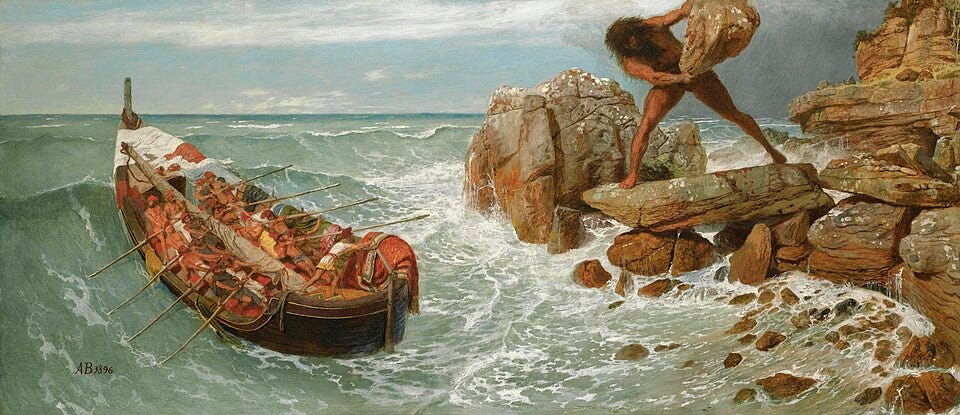
image via Wikimedia Commons. Public Domain.
Turning to the actual movie, it’s probably too early to say if The Odyssey is going to sweep the Oscars, but I could absolutely see that happening. It feels like the perfect blend of the high-minded ‘proper’ filmmaking the Academy loves and it’s clearly popular with normal people.
Seriously, this movie is going to make so much money.
Granted, it was a Saturday night, but I did not expect a regular-screen showing for a movie marketed as ‘You must see this in IMAX’ to be so busy. I guess a lot of people were hoping to see the sold-out IMAX showing and settled, too.
At the very least, it’s inevitably going to get a huge amount of nominations. Matt Damon and Anne Hathaway are probably going to get nominated for Best Actor and Actress. I think there’s a pretty good chance one of Tom Holland gets a nomination of Best Supporting Actor. I think there’s a non-zero chance Charlize Theron gets the nomination for Best Supporting Actress.
It is absolutely going to get the nominations for Best Director, Picture, and Score and will probably win those. I think there’s even a decent chance it gets nominated for Best Adapted Screenplay, too…
The one technical category I could see it not getting a nom for is Costume Design – and even then, I think stuff like Darth Agamemnon might win the nominators over.
The Man for Wisdom’s Arts Renown’d

Photo by neslihan u0b68u09ce on Pexels.com
A friend of my brother’s – knowing that I have a Classics MA – actually told him to warn me that Nolan’s Odyssey isn’t exactly like the book.
More than a few people online have pointed out that the original Odyssey is not, in fact, a book. But, realistically, if you read the Odyssey, you read it as a book, so that point really isn’t worth quibbling over.
My response was basically “How bad can it be? I survived Troy.”
Troy was a bad movie and a terrible adaptation. I’m happy to report that The Odyssey is a phenomenal movie and a pretty good adaptation. Yes, it isn’t exactly like Homer’s version, but I think I can understand why Nolan did most of the things he did for the sake of making Homer’s story work better as a movie.
It’s a Christopher Nolan movie.
You can take the production values for granted. I can’t find a definitive source, but I remember a Reddit comment mentioning that they built a 15-foot tall Cyclops puppet – Nolan talks about the puppet and animatronics in an interview, but I can’t get a figure on its exact size. There are probably moments where Polyphemus is motion-captured CGI, but the only thing that I think I could tell was purely CGI was Scylla. Everything else was either practical effects and sets or was well-executed enough to pass as real sets.
My brother and I both agreed that The Odyssey looks really expensive. But, again, it’s going to make so much money.
No part of The Odyssey made me irrationally angry like a lot of Troy did. Admittedly, that’s potentially because I’m twenty years older (ugh) and more mature than I was watching Troy in middle school. I’m a grown-ass man and I’d rather not waste my energy being mad at a movie.
That being said, I did have a few issues with it.
I’ve seen comments online about how the movie feels too grounded, and I think I agree with that.
While The Odyssey doesn’t show the same outright contempt for Myth that Troy did, its mythological components are all fairly plausible and down-to-earth rather than truly larger-than-life: Polyphemus seems to have one eye because of deformities rather than because he’s just a Cyclops and that’s the why Cyclopes are (though he is also literally a giant), the Underworld is really just Odysseus and his men standing on an admittedly bleak and forlorn beach – presumably in Cimmeria (not that Cimmeria), Athena may just be a manifestation of Odysseus’ guilt but a thunderstorm does start right as Odysseus reveals himself back in Ithaca. Scylla is some kind of tentacle-monster that we never really get a good look at. That does sort of add to the horror of her, but I must admit that I was sort of hoping that Nolan would go full-on ‘sea monster with dogs for a lower body…’
On the flipside, Circe and Calypso are clearly magical, Polyphemus and the Laestrygonians are clearly not normal humans, Scylla is clearly some kind of monster, Odysseus is talking to the actual, literal ghosts of the Greeks who died at Troy.
The movie starts with a title card that reads “In a time of apparent magic.” On the one hand, that does sort of tell the audience to temper their expectations on the mythological aspects of the story. On the other hand, I think that does also mean that what we’re seeing isn’t what really happened. I’ll get more into this a little later on, but towards the end, Odysseus laments that the collapse of the Bronze Age means that there will be nothing left of his era than songs that won’t fully remember what actually happened.
So, I think it’s possible to interpret that we’re seeing on screen is actually the garbled, distorted, mythologised account of the real-world history. So, based on that, it’s possible to read the Laestrygonians as a distortion of the historical truth of the rise of armies using iron weapons and that Scylla’s vague, fleeting appearance as the result of the later tellers of the story not having any concrete information on what she actually is beyond “Monster that ate Odysseus’ dudes.”
Even if Athena is just Odysseus’ sub-conscious speaking his own inner thoughts, she still lays out the movie’s fundamental statement on the nature of the gods. When he asks her why the gods don’t communicate clearly with humans, she responds by asking him ‘Who doesn’t understand fire?’ Notably, the last of Odysseus’ crew only die for good after they break an oath they’ve sworn to him, so there’s a real sense of the gods punishing mortals (often including Odysseus) for their misdeeds.
Which is, of course, entirely par for the course in Greek mythology.
The Age of Myth is Ending

image via Wikimedia Commons. Public Domain.
As I saw it, my big takeaway from this version of the story is that the central premise is that the Age of Myth is ending and the Age of History is beginning.
Nolan situates his version of the Trojan War heroes’ nostoi on the eve of rumoured invasions throughout the Mediterranean by strange People from the Sea. The so-called Sea Peoples are real – or at least a real hypothesis – a group of unidentified raiders who attacked Egypt and other regions of the Eastern Mediterranean towards the end of the Bronze Age.
Mycenaean-era Greek may have been included among their number, and it’s been suggested that the Biblical Philistines were ultimately of Greek origin. It’s difficult to establish events in the Bronze Age with much certainty, so how exactly the Sea Peoples contributed to the Late Bronze collapse is still unclear, but Nolan runs with it.
Essentially, the Trojan War represents the fundamental breach of the underlying customs and rules of engagement that governed the Bronze Age, ushering in an unprecedented period of upheaval and violence that the world as it exists is utterly unprepared for.
That way, The Odyssey is sort of like a Bronze Age counterpoint to Oppenheimer…
Again, it’s difficult to establish exactly what happened, but we know that large-scale polities and intercontinental trade routes did collapse at the end of the Bronze Age and there was widespread violence and destruction at the former Mycenaean palace sites, leading to the to the rise of small, localised communities in their place.
Notably, one of the reasons that the Bronze Age is followed by the Iron Age isn’t because iron makes better weapons and armour, it’s because iron ore was simply more accessible than bronze after copper and tin could no longer be imported.
All of which is say, by establishing the Trojan War as the ultimate, if not immediate, cause of the Bronze Age collapse, Nolan is situating his story in a real, definable period of time. This is actually consistent with the Ancient Greeks’ own conception of history, with the Fall of Troy being one of the earliest events they believed they could set a date for – at some point around 1200 BC.
Coming Home
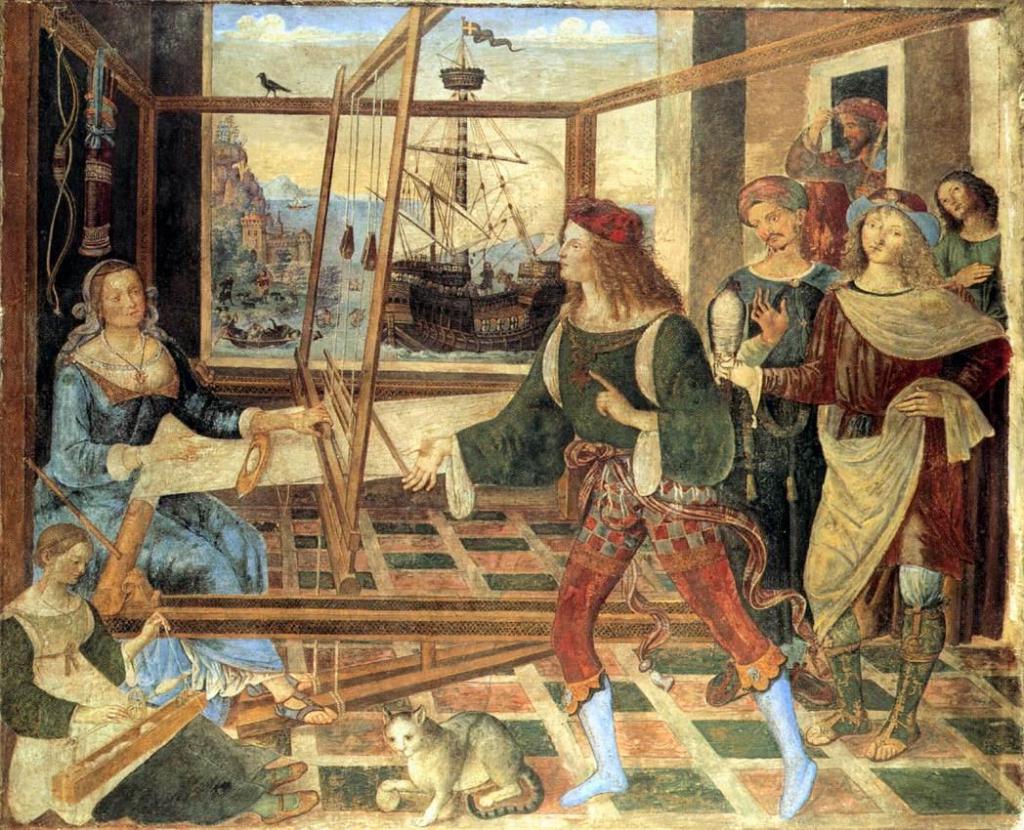
To bring this post home, I think it’s pretty clear from watching The Odyssey that Christopher Nolan is – and in mean this is the most complimentary way – a crazy person.
It’s clear that he’ll go to ridiculous lengths to make his movies and it’s clear that he respects his craft – probably more so than he respects the Classics, but I think he also at least cares about said Classics to use them as best he can to make his movies.
Again, I think I agree that The Odyssey doesn’t go far enough with the mythical tone, but Christopher Nolan, of all people, also isn’t going to cheap out or phone in the effort involved. The Odyssey may not be as mythical as it could or should have been, but it is absolutely an epic – and quite a well-paced one, too. It definitely did not feel 3 hours long. I’ve been more bored watching shorter movies…
And, as a final note, as we were driving back from the theatre, the most Odyssey-y thing that could have happened did happen.
We got lost trying to get home.
Now, a quick reminder that I am a professional writer and editor, and if you’re in need of writing and editing support, please consider taking a look at the work and rates currently offered by Emona Literary Services™ and reach out if you think I can help you.
Please consider supporting Emona Literary Services™ to help me expanding my publishing and content creation projects, via Patreon, Ko-fi, or directly through Paypal by scanning the QR code below:

You can follow me on my various social media platforms here:
© Joel Balkovec — Published by Emona Literary Services™.

This work is licensed under a Creative Commons Attribution-NonCommercial-NoDerivatives 4.0 International License.
The author prohibits the use of content published on this website for the purposes of training Artificial Intelligence technologies, including but not limited to Large Language Models, without express written permission.
All stories published on this website are works of fiction. Characters are products of the author’s imagination and do not represent any individual, living or dead.
View the Emona Literary Services™ Privacy Policy here.

 Emona Literary Services

Leave a comment