
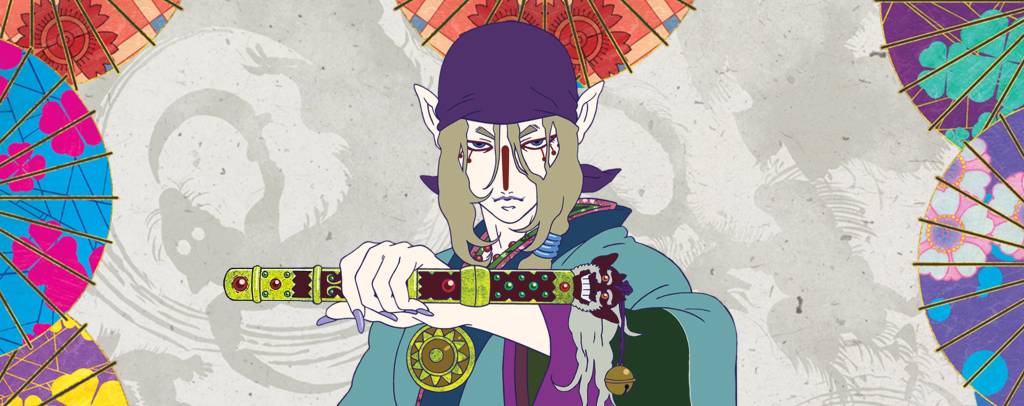
First things first: no, this post is not about Studio Ghibli’s classic anime film Princess Mononoke. Though I will freely admit that Princess Mononoke is likely my favourite Ghibli movie.
Incidentally, re-watching Princess Mononoke as the first time since I was a kid and renting it from Blockbuster Video (‘member Blockbuster Video?), I had clearly forgotten how violent the movie was. To the point that I was sitting there thinking “Wow. If my parents knew, they never would have let me rent this movie.”
Kid Joel really dodged a bullet there. Unlike all the animals who got shot in Princess Mononoke…
Ahem.
Given the similar names and Princess Mononoke being significantly better-known, I’m pretty sure I have to make that clarification every. single. time. I’ve tried to talk to someone about Mononoke.
For the record, “Mononoke” is just the Japanese word for something like ‘ghost’ or ‘spirit.’
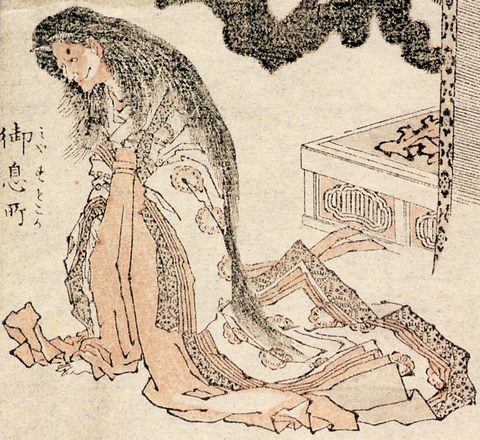
Admittedly, that’s plot-relevant to both, but beyond both anime being about supernatural beings, they really don’t have that much in common.
Second things, um, second: As much as I want to talk about Mononoke to the greatest extent possible, I’m going to focus on the 12-episode anime series. I think the movie trilogy is actually a better showing, but as I post this, the third movie has only just become available internationally on Netflix.
Expect a follow-up post looking at the movies when the third movie – Hebigami in Japanese, The Curse of the Serpent in English – hits Netflix and I’ve had time to, you know, actually watch it. I’m hoping to do that next week.
I’ve previously mentioned that The Book of the New Sun is one of my favourite books despite, as I’ve described it, being “the most impenetrable book I’ve ever read not written by a German philosopher.”
Shadow and Claw: The First Half of The Book of the New Sun: Tor Essentials.
Mononoke is basically the anime equivalent of that.
The animation and art direction is a big part of that. Now, this clip is from the first movie in the trilogy that’s come out over of the past few years – most of the good clips I could find are posted by Netflix about the movies. I’m going to devote a separate post to the movies, but this gives a good glimpse into how – and I get to dust off a fantastic word here – phantasmagoric the anime is:
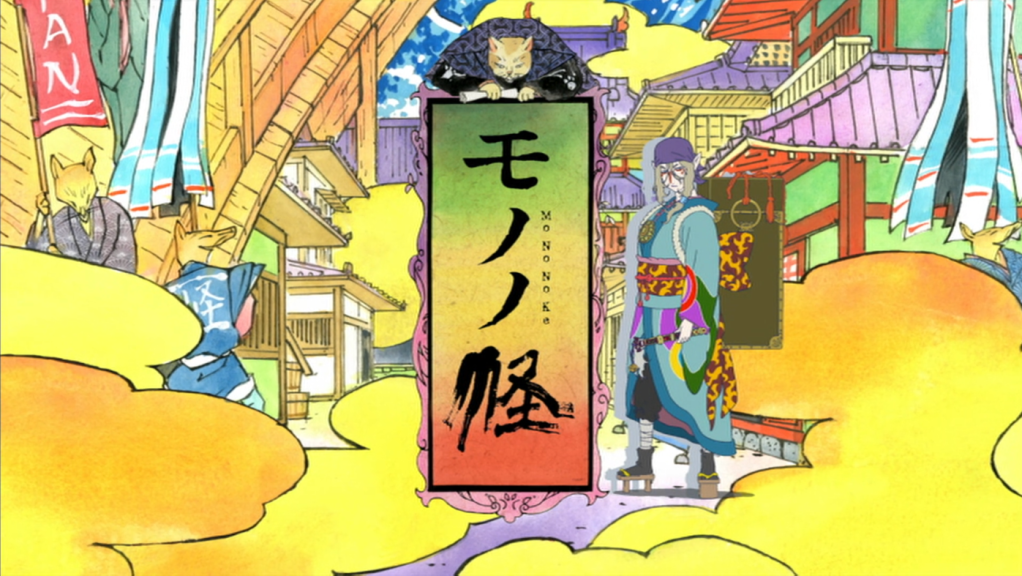
Based on a story arc from the Japanese folklore-themed horror anthology anime series Ayakashi: Samurai Horror Tales (which I don’t believe is currently available to watch anywhere legitimately), Mononoke follows a mysterious but clearly not human Medicine Seller who seems to have a knack for turning up right as somebody is being haunted by a Mononoke.
Each story arc plays out as sort of a combination of a detective show and an exorcism movie: The three things the Medicine Seller needs to learn about a Mononoke to be able to draw his sword against it vary in specific translation across different versions, but the International version available on Crunchyroll and Netflix uses Shape (the other most common translation is Form), Truth (pretty consistent across versions), and Reason (or Regret).
Regardless of how exactly those three things are translated, they boil down to what it is, why the spirit turned into a mononoke in the first place, and what it wants to accomplish. The bulk of each storyline is spent honing in on those three things.
Mononoke is a horror series, but even though I’ve watched both the TV series and the Netflix movies several times, I’ve found it more unsettling than outright scary.
There are a few jump scares [That link is not one, I swear], some of which are genuinely effective, but for the most part, the scariness comes the mounting tension and sense of dread that builds up in each storyline, not helped by the art style that I find really overstimulating.
The storylines don’t really give the viewer a lot to work with. There’s clearly a lot going on, a lot of visual symbolism and metaphor, and a lot of unspoken implications. But very little of it is every explicitly explained or spelled out to the viewer. Having some knowledge of Feudal Japanese society, Japanese folklore, and Buddhist spirituality might help viewers decipher things.
The Medicine Seller himself is clearly not human (popular theories on the Internet seem to favour him being a kitsune – given the animal ears and fangs, that would make sense). He has a magic sword and talismans purpose-built to exorcise mononoke. Notably, the Medicine Seller is a merchant. Merchants were the lowest class in Edo-period Japanese society and my understanding is that he wouldn’t even legally be allowed to carry a sword. Even notwithstanding the fact that he’s unnaturally pale, has Elf-ears, fangs, and is obviously magic he’s clearly not a normal human being.
Though, given the nature of the show, I don’t think we can discount the possibility that the way we as viewers see him is necessarily how the other characters in-universe perceive him. And he does mention that he dresses as weird as he does as part of his wandering peddler act.
Incidentally, the movie trilogy does elucidate at least some of the nature of the Medicine Seller, but given the potential for spoilers, I will hold off saying anything more here.
The series is twelve episodes long, divided into five story arcs that alternate between two and three episodes long. Each episode is essentially self-contained, though the Medicine Seller does encounter a character from the Ayakashi story arc and another character heavily implied to be that original character’s future reincarnation.
Each of the five arcs follows the Medicine Seller as he unravels the mystery around the eponymous Mononoke of each arc:
- Zakishi-warashi involves a pregnant mother hiding from the assassins hired by the noble father of her unborn child in an inn with a dark past haunted by the ghosts of children.
- Umi-bozu involves a ship adrift in the Devil’s Sea – a real stretch of ocean south of Japan with a reputation as the Pacific’s Bermuda Triangle.
- Noppera-bō is almost a legal procedural, with the Medicine Seller and a faceless Mononoke serving as the opposing counsel in the case of a woman who’s confessed to killing her abusive husband’s family.
- Nue follows the competition of a group of a wealthy noblewoman’s suitors as they attempt to prove their mastery of the arts of ceremonial incense – and quickly becomes a murder mystery the Mononoke makes itself known.
- Finally, the Bakeneko arc hearkens back to the first Bakeneko storyline of the original Ayakashi anthology and plays out sort of like a really trippy adaptation of Murder on the Orient Express – and is particularly confusing because it’s clearly set in a much later time period (somewhere in the Taishō era based on the fashion and society). Naturally, this passes without comment…
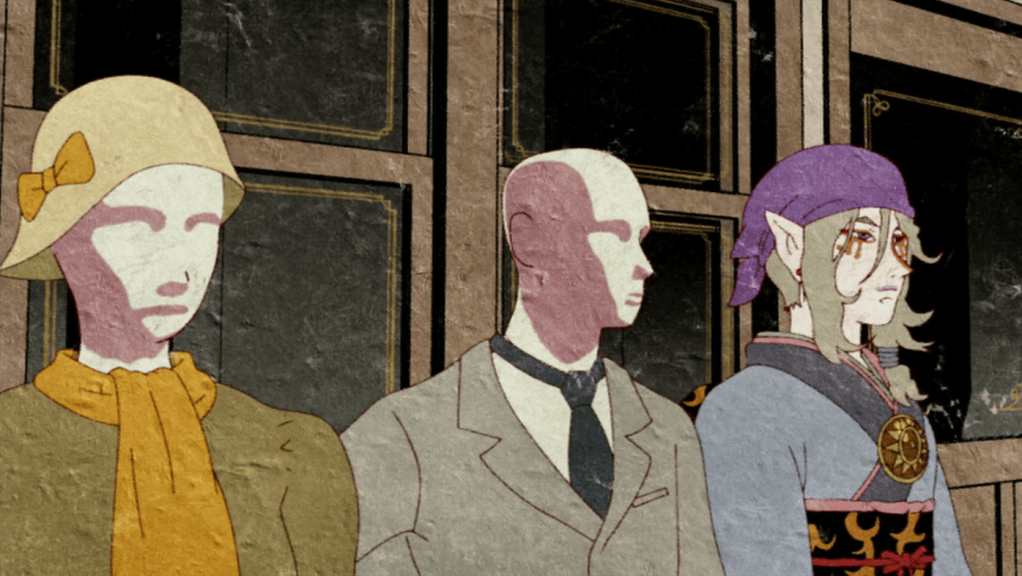
Even though I linked to the Wikipedia article for each of the types of Mononoke, I don’t think doing that really spoils anything – the way they’re depicted So, even knowing ahead of time that the Zakishi-warashi are ghost children, or the Umi-bozu is a sea ghost, or the Bakeneko is a cat doesn’t really indicate that how much of how exactly they function within the storyline.
The twist on the Noperra-bō is particularly interesting…
One the one hand, since Mononoke are establised to be human spirits that have basically gone insane due to clinging to some grudge or injustice, there’s a clear undertone of ‘Humans are the real monsters’ in Mononoke – all of the Mononoke themselves are either angry human spirits, or at least spirits created directly by humans doing something terrible.
On the other hand, I’ve found Mononoke to be very uplifting and affirming. The Medicine Seller isn’t necessarily nice, he can be sarcastic and abrasive to the point of being mean to the human characters, but he’s still clearly a force for good.
Despite the historical setting and demon-centric plots, this isn’t like Demon Slayer where he’s killing the Mononoke in intense, high-action fight scenes. Once he’s able to draw his sword after unravelling the mystery of the Mononoke he’s facing, he’s preparing for an exorcism and his end goal his to purify the Mononoke and put them to rest.
On top of that, most of the human characters end up growing and improving as people and generally walk away with a greater sense of their own humanity and the value of human life.
For as genuinely disturbing and unsettling as Mononoke can be, there’s actually a bizarrely heartwarming thematic core.
Mononoke can be viewed on both Netflix and Crunchyroll. Internationally, the movie trilogy is licensed by Netlfix.
Now, a quick reminder that I am a professional writer and editor, and if you’re in need of writing and editing support, please consider taking a look at the work and rates currently offered by Emona Literary Services™ and reach out if you think I can help you.
Please consider supporting Emona Literary Services™ to help me expanding my publishing and content creation projects, via Patreon, Ko-fi, or directly through Paypal by scanning the QR code below:
You can follow me on my various social media platforms here:
© Joel Balkovec — Published by Emona Literary Services™.

This work is licensed under a Creative Commons Attribution-NonCommercial-NoDerivatives 4.0 International License.
The author prohibits the use of content published on this website for the purposes of training Artificial Intelligence technologies, including but not limited to Large Language Models, without express written permission.
All stories published on this website are works of fiction. Characters are products of the author’s imagination and do not represent any individual, living or dead.
View the Emona Literary Services™ Privacy Policy here.


Leave a comment