
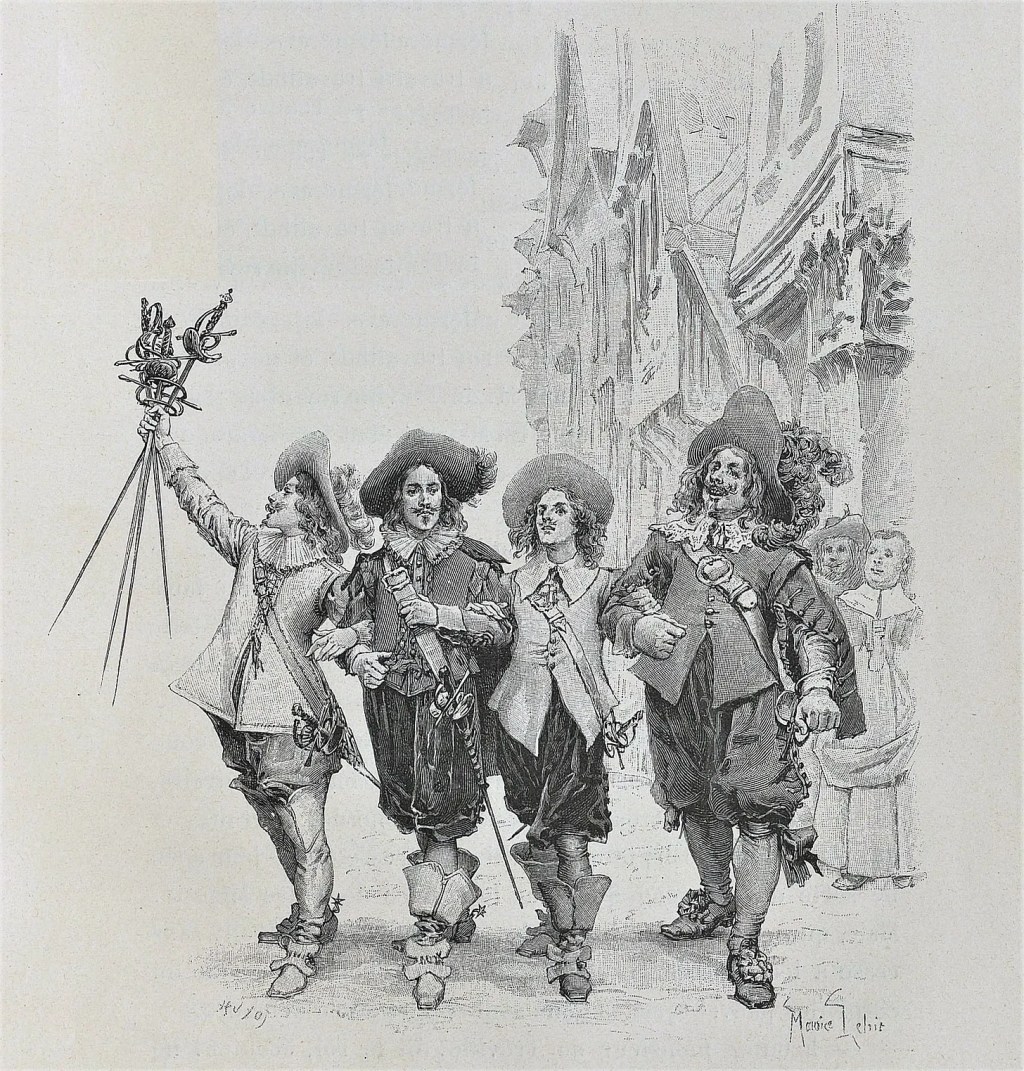
Although I did manage to force myself to finish The Count of Monte Cristo…

Image by Visitor7, via Wikimedia Commons. CC BY-SA 3.0
…through sheer, stubborn force of will, I’ve never actually managed to get all the way through The Three Musketeers.
I think that may be a pretty common occurrence, actually. It would certainly explain why some many of the adaptations of The Three Musketeers feel like they basically have nothing common with the source material.
For today, I’m going to focus on two of those adaptations that I actually have something of a soft spot for: Disney’s 1993 version, and the 2011 version from Paul W.S. Anderson — who, for as many movies as he’s released that have been eviscerated by critics, also gave us the 1995 Mortal Kombat, which is probably at the pinnacle of Good Bad Movies.
For today, I’m going to focus on two of those adaptations that I actually have something of a soft spot for: Disney’s 1993 version, and the 2011 version from Paul W.S. Anderson — who, for as many movies as he’s released that have been eviscerated by critics, also gave us the 1995 Mortal Kombat, which is probably at the pinnacle of Good Bad Movies.
Without going on too much of a tangent, the 1995 Mortal Kombat is legitimately one of my favourite movies. It’s a not a good movie, but I would argue that it is absolutely a successful one. For one thing, basically the entire cast is perfect – and, in fact, Kano’s actor was so perfect that the video games retconned the character to make him Australian (ironically, the actor was actually English and playing Kano as a Cockney, viewers just didn’t recognise the accent). Its greatest strength is that everyone involved seem to know exactly what kind of movie they were making and went all-in on making it both exactly the right kind and right quantity of Stupid.
In fact, my biggest complaint about the 2021 Mortal Kombat is that it’s not Stupid enough…
Ahem.
Disney’s 1993 Three Musketeers
I distinctly remember that I watched this movie with my best friend when I was kid. I distinctly remember opening the door to the storage room in his house where the toy swords were and then going wild.
But I remembered absolutely nothing about the movie.
So, when I stumbled across it on Disney Plus, I went “Hey! I remember that” and watched it for the first time in at least 20 years. I was almost immediately ashamed of myself for forgetting everything I used to know about it…
I love this movie!
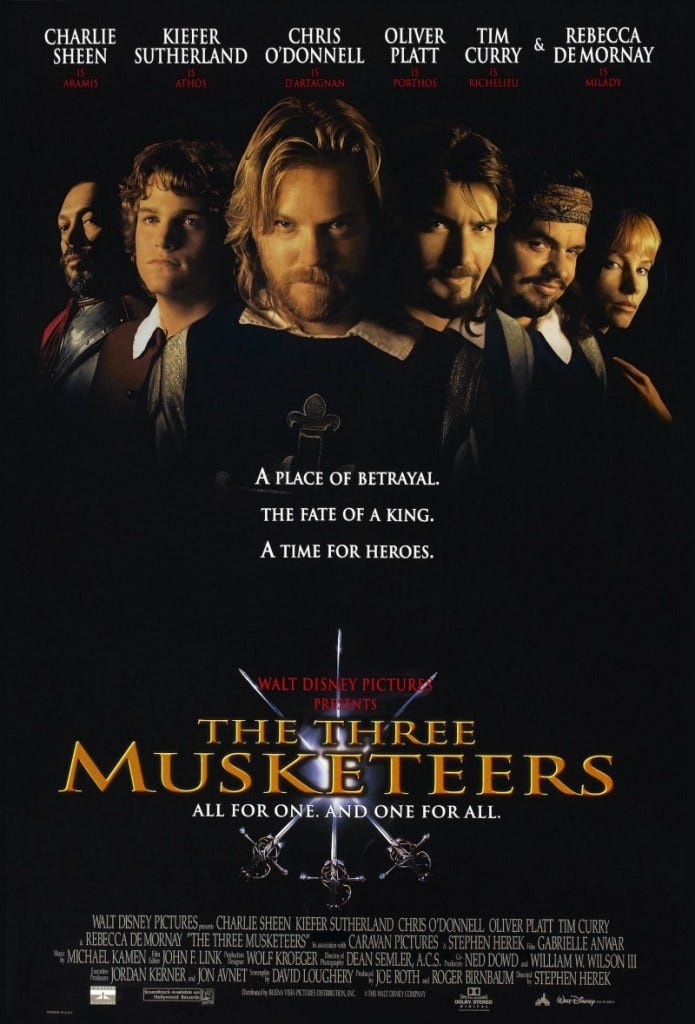
For the sake of brevity, I’m not going to dive too deep in explaining why it’s probably pretty challenging to make a faithful adaptation of the original The Three Musketeers. So I’ll just contextualise this version (and, in fairness, also the 2011 version) in thusly: Anyway, back to the movie. Like we’ve established, it’s an adaptation of the original novel.
In much the same way Star Wars is an adaptation of samurai movies…
Photo by Mikhail Nilov on Pexels.com
Even though the plot has only about a 3% connection to the source material, the main characters are all how they’re supposed to be: d’Artagnan is young, hot-blooded and constantly picking fights, Athos is grim and stoic, Aramis is well-read and constantly trying to seduce married women, and Porthos is jocular but vain and self-absorbed.
On the other hand, primary antagonist Cardinal Richelieu is downgraded from ruthlessly pragmatic master of realpolitik (much as he was in real life) to cackling, moustache-twirling supervillain, played by Tim Curry in a rare villainous role (I’ve made that joke before).

Photo by cottonbro studio on Pexels.com
Basically, in the book, Richelieu is antagonistic, but not evil. He may be at odds with the Musketeers, but he genuinely has France’s best interests in mind (as you’d perhaps expect from the Prime Minister of France). In fact, he actually works with the Musketeers at certain points in the novel.
Similarly, Rochefort — the Darth Vader to Richelieu’s The Emperor, so to speak — is changed from a worthy opponent to the Musketeers who ultimately ends up allied with them to … a moustache-twirling supervillain. He has no depth, gets not character development, and exists primarily to be defeated in a big, awesome climactic sword fight.
That’s not necessarily a bad thing, though. I’m always down for a good cinematic sword fight.
Aside from the fact that absolutely nobody is even remotely trying to be French — or even acting all that hard, for that matter — the casting is pretty good.
Kiefer Sutherland is getting some solid practice in for Jack Bauer as Athos, Tim Curry is turning in … every Tim Curry performance ever, Charlie Sheen somehow manages to be simultaneously horribly miscast and absolutely perfect as Aramis, Chris O’Donnell delivers d’Artagnan‘s youthful exuberance and hot-bloodedness, and while Oliver Platt doesn’t really look big enough to be Porthos, he absolutely nails the swaggering, boastful, “I’m BFFs with the Queen of America” — no, that statement doesn’t make sense, yes, that’s the point — aspect of the character.
Also, he fights a ninja for reasons that are never made entirely clear.
Yeah, it’s that kind of a movie.
If, for some reason, you’re really passionate about the integrity of Alexandre Dumas’s original stories, you should probably not watch this movie.
Or any adaptation of his work, really…
Paul W.S. Anderson’s 2011 Three Musketeers
Somehow, the 2011 version manages to play even faster and looser with the source material than the 1993 version. As many liberties as that version took with the story, it was still at least grounded in the real-world historical setting of Ancien Régime France. It was goofy, but Athos never, like, pulled out a mounted machine gun and started blasting…
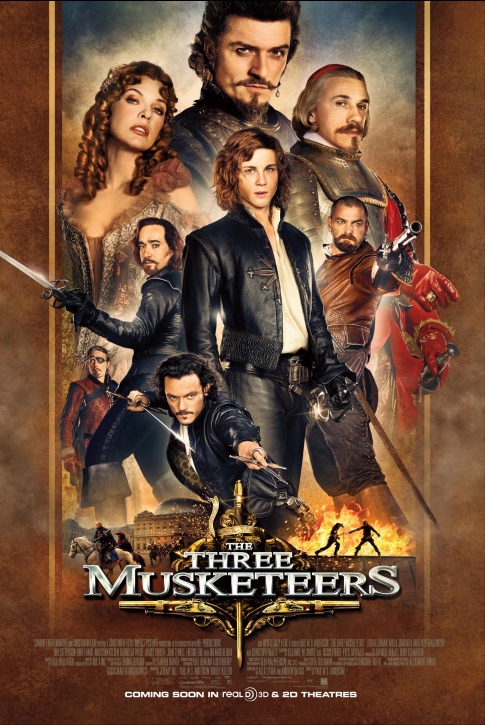
Somehow, the 2011 version manages to play even faster and looser with the source material than the 1993 version. As many liberties as that version took with the story, it was still at least grounded in the real-world historical setting. It was goofy, but Athos never, like, pulled out a mounted machine gun and started blasting…
On the other hand, this version is pretty much running on full-on video game logic:
Yes. Those were sky-boats…
I don’t even mean the “video game logic” thing negatively. I suspect that it’s going to be a deal-breaker in itself for some people. But, as for me, I think the most over the top aspects go a long way in making it enjoyably Stupid.
Yes, it’s absolutely nonsense, but at least it’s not just a retread of the familiar story.
Plus, we get to enjoy (the famously Germanic) Christoph Waltz in a rare villainous role as this version’s (famously French) Cardinal Richlieu.
Especially considering that there are sky-boats and big explosions and that general sense video game logic, the movie is unexpectedly faithful to the general bones of the original story, just filtered through the conventions of big budget filmmaking, Paul W.S. Anderson’s approach to filmmaking – in particular his tendency towards “Have I reminded you lately that I’m married to Milla Jovovich?” – and that general sense of video game logic.
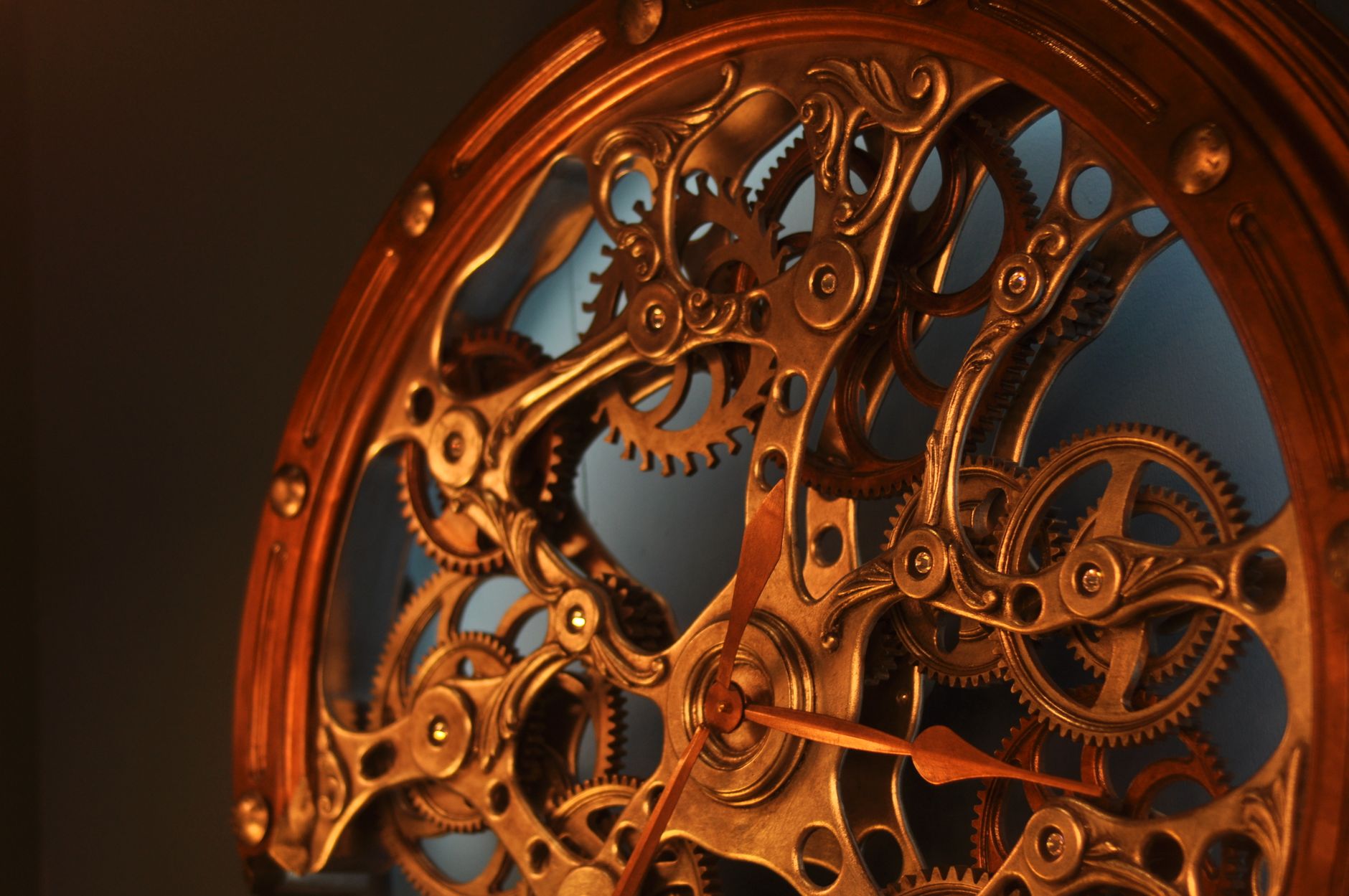
I’m a bit conflicted. On the one hand, I think making a movie an original — I guess it would be “Clockpunk” for a world based on the 1620s — either Fantasy story or at least a clear Alternate history probably would have mitigated the worst of the “This is stupid” reactions, but also probably would have been less marketable than an adaptation of one of the most popular books of all time. On the other hand, I’m not really sure how powerful The Three Musketeers branding would have been in 2011.
Granted, even with “The Three Musketeers” name, the film still didn’t perform well at the box office (though how much of that is because it’s a bad adaptation is unclear to me). But, for what it’s worth, it was actually less of a bomb that I expected, at least based on the numbers I’m seeing. Admittedly, I don’t know enough movie math to know the exact formula for a movie’s financial success, but that a movie needs a box office of 2-2.5x its budget to break even.

So, ballpark, on the movie’s $75 million budget, it needed somewhere between $135 and $180. It ended up making $132. So, yeah, it lost money, but it wasn’t a “Bankrupt the Studio” type failure. And there are a few silver linings in its performance: it did top the box office in its opening weekend and it was pretty well-received in Japan – making more money in American dollars in Japan its opening weekend than it did domestically.
Like with the 1993 version – and fittingly, since this is a Paul W.S. Anderson movie – the 1995 Mortal Kombat, a movie like this has no business having a cast this good. Fittingly, the main four are probably the high point: Matthew Macfadyen (Athos), Luke Evans (Aramis), and the late Ray Stevenson (Porthos) all execute their characters well as the title three. Logan Lerman (d’Artagnan) is incongruously American and kinda boring, albeit in a way that sort of fits the character.
Milla Jovovich as Milady de Winter is basically every character Milla Jovovich has played in any Paul W.S. Anderson movie she’s been in. Which is definitely one of the video game logic aspects of the movie, but at least fits tonally with the actionisation and overall badass-ification of the source material…
Of course, like in 1993, nobody is trying to sound particularly French, Christoph Waltz is basically just being Chrisoph Waltz (not necessarily a bad thing), and at least the English Orlando Bloom is playing the (delightfully catty) English Duke of Buckingham.
I think that alone means it has a more accurate cast than the 1993 one did…
All things considered, it’s probably the perfect streaming movie (as of this writing, it’s on Tubi, at least in Canada). I think being able to watch it from the comfort of home, without having to spend a dime probably goes a long way in getting more enjoyment and entertainment out of it. At the expense of repeating myself, it’s not necessary a good movie, but it’s at least silly enough to be enjoyable. It perhaps still takes itself a little too seriously, has too many shots with unnecessary slow motion, and overall feels like less of a fever dream than the 1993 version (possibly the result of having vague childhood memories of the 1993 version), but does still have enough moments of sky-boats and big explosions to prove that it does, deep down at least, know exactly what kind of movie it is.
Obligatory reminder that it was a book first…
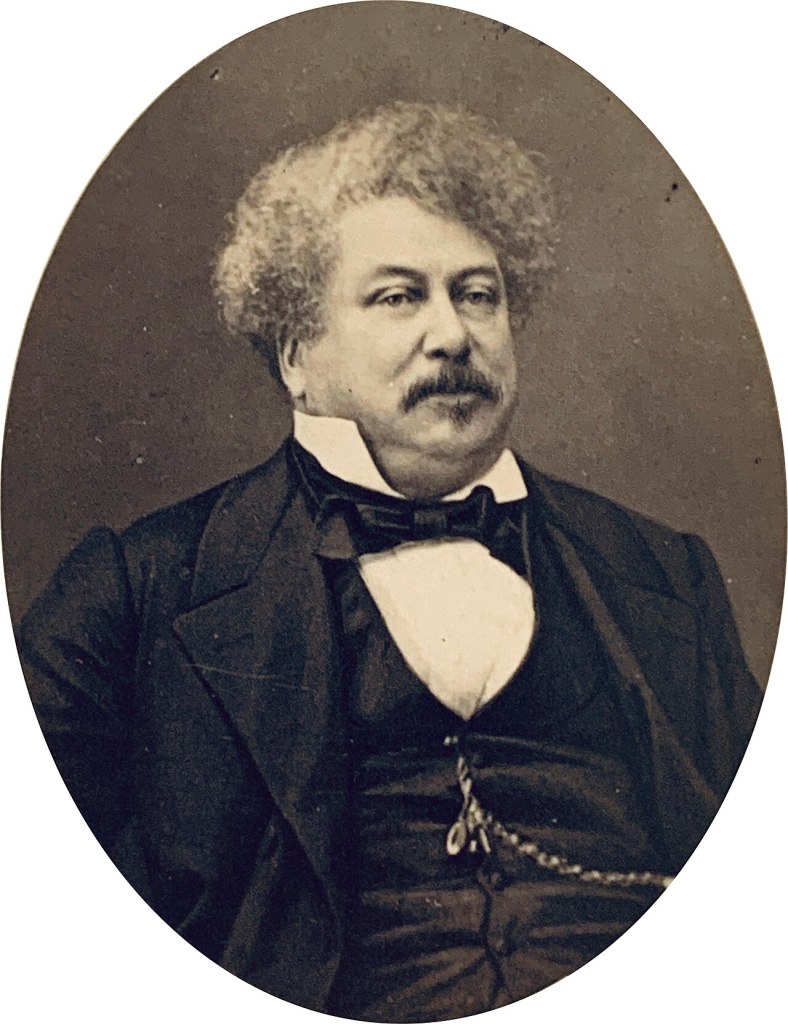
To circle back the point I was making at the top of this post: I’m not sure there’s ever actually been a faithful adaptation of the original Three Musketeers novel.
There are a lot of peculiarities with the book that make it hard to put on film. For one thing, it was written (in French) in 1844 and set in the 1620s (in France), so there’s a lot of cultural and artistic tastes and preferences that have changed since then.
For another, it’s not nearly as exciting as most adaptations make it out to be. It’s not really an action story. Honestly, it’s more of a Ancien Régime-era spy novel. Basically, Cardinal Richelieu (a real person, by the way) is trying to do something dastardly to discredit the Queen, so he can manipulate the King, so he can fight the Spanish better.
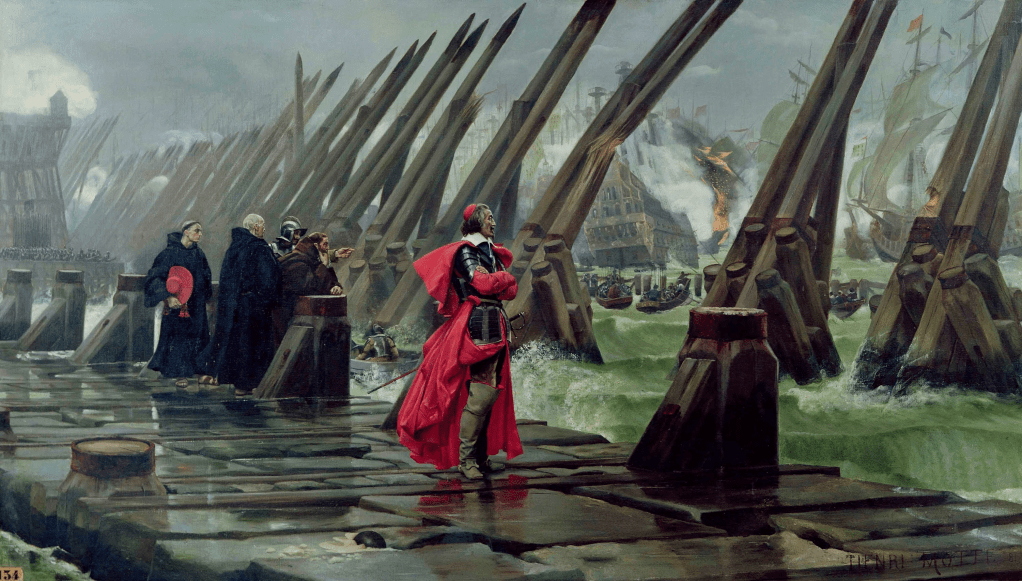
Siege of La Rochelle: Henri-Paul Motte. Public Domain. Via Wikipedia.
And, in fact, both the versions I looked at in this point, do work with that plot point. And then go completely off the rails with it…
If anything, most adaptations feel like they’re taking almost a commedia dell’arte approach to the original novel: using the characer archetypes and some of the general plot beats to build an entirely new story.
See, for example, the Three Musketeers anime from 1987 (that I can’t find available on streaming as of this writing) that goes pretty fast and loose with the source material. d’Artagnan’s twelve, Aramis is a woman in disguise, the Man in the Iron Mask is basically a supervillain and the main bad guy, and the plot is less based on the book and more just a series of vaguely swashbuckling 17th-centry adventures that occasionally align with the plot beats of the novel.
Potentially the most pressing issue in adapting the source material is that narration of the novel is, admittedly, rather long-winded and not always on topic (it was originally published in serial, so it kind of had a vested interest in not getting to the point), but it’s very conversational and absolutely full of snarky little comments and shots at the characters and events. It’s probably my favourite part of the novel, but, again it’s not something that you can really convey on film, unless, perhaps, you’re going to include a Wonder Years-esque voice over to keep up a running narration.
Which, honestly, doesn’t seem like a terrible idea….
Now, a quick reminder that I am a professional writer and editor, and if you’re in need of writing and editing support, please consider taking a look at the work and rates currently offered by Emona Literary Services™ and reach out if you think I can help you.
Please consider supporting Emona Literary Services™ to help me expanding my publishing and content creation projects, via Patreon, Ko-fi, or directly through Paypal by scanning the QR code below:
You can follow me on my various social media platforms here:
© Joel Balkovec — Published by Emona Literary Services™.

This work is licensed under a Creative Commons Attribution-NonCommercial-NoDerivatives 4.0 International License.
The author prohibits the use of content published on this website for the purposes of training Artificial Intelligence technologies, including but not limited to Large Language Models, without express written permission.
All stories published on this website are works of fiction. Characters are products of the author’s imagination and do not represent any individual, living or dead.
View the Emona Literary Services™ Privacy Policy here.


Leave a Reply