

Casino Royale is problematic in a lot of the same ways the movies are, and perhaps more so, because even the earliest of the Bond movies had at least 10 years of society marching on working in their favour. For reference, Casino Royale is older than my parents…
James Bond has been a Pop Culture keystone for long enough that we’ve probably all seen at least one Bond movie and we know what we’re getting into at this point in terms of sex and violence and British jingoism. While I do understand that the books are notably different from the movies, based on my experience, the books are still similar enough to the movies that if the problematic aspects of the movies are too much for you to get past, that will also be true of the books.
And, like, fair play. I’m not the boss of you. Enjoy what you enjoy.
But, if you are interested in Casino Royale, here’s a bit more about it.
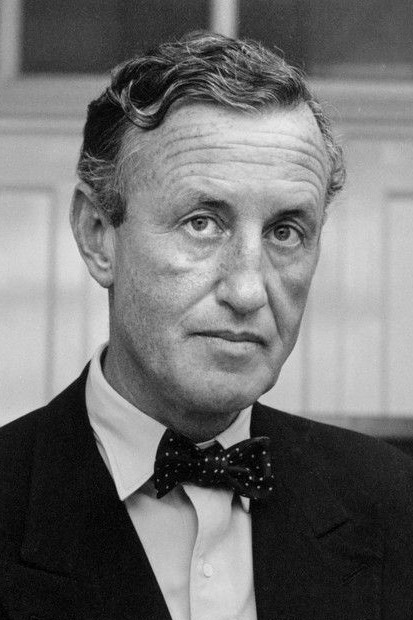
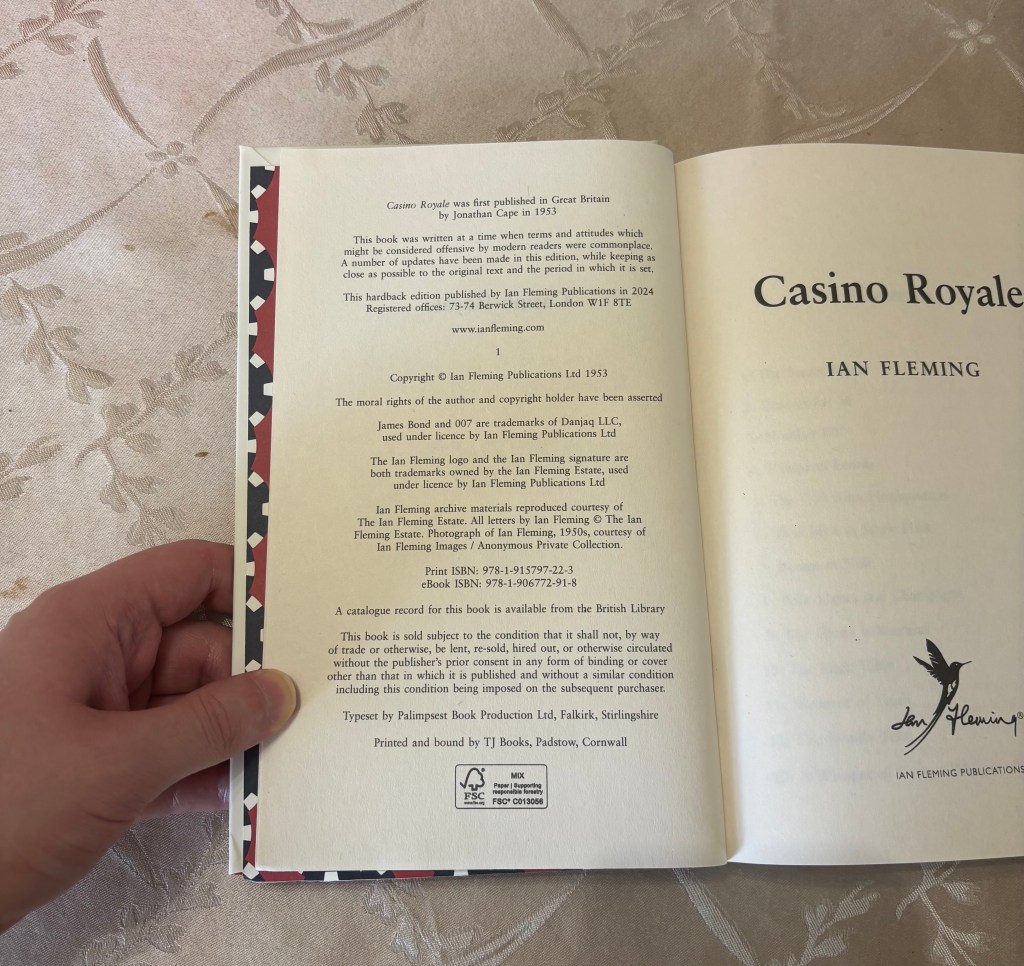
Casino Royale was written by a white British man in the early 50s, as we see above. And it shows. In fact, the fairly recent edition I have has a little disclaimer about how the views and opinions expressed by the text are a product of their time, may offend modern readers, and do not represent the views or values of the publishers:
Most prominently, the book feels really condescending towards Vesper. She’s treated and presented like a naive, hapless child, even though she’s a professional spy with at least a decade of experience – though I’m not entirely sure how much of that is the detached narration separate from Bond’s subjective opinions. She doesn’t really do anything other than be Bond’s arm candy (which, as far as I can tell, is literally why she was assigned to the operation) and something for him to lust over.
There’s also a moment where Bond describes one of Le Chiffre’s minions as looking like a “Corsican shopkeeper.” Now, I’m not sure if that’s supposed to be an insult, but I’m not sure of any other way to possibly parse that statement. Even if it’s meant to be entirely neutral, it just feels bizarre to read in 2026.
Even just the fact that everyone is smoking all time and Bond himself is noted as smoking something like 50 cigarettes in a day raised a couple eyebrows from me.
If I could describe Casino Royale in one word, it would probably be “abrupt.”
It’s barely 200 pages and about 30 chapters long. You could read a chapter a day and be done in a month, but given how quick the individual chapters are, you could definitely keep a faster pace than that. Honestly, a strong/fast enough reader could get through it in a day. As a consequence of that, the plot beats come quickly and constantly, but none of them really get much time to breathe or develop.

Casino Royale is fundamentally a book about a card game. Now, since that card game is baccarat, something I know nothing about, I did actually appreciate that there’s an entire chapter devoted to explaining how baccarat works. TL;DR: it’s basically blackjack with 9 instead of 21.
On top of that, Bond’s inner monologues about gambling in general do offer a pretty interesting insight into his psyche and philosophy.
Admittedly, striking a blow agains an evil, communist espionage network through cards does kinda sound ridiculous on the face of it, but the whole plan is to bankrupt Le Chiffre, who’s funding Soviet activities in France, with the likely added consequence of turning him into a liability, and therefore a target, to SMERSH.
Quick sidebar: SMERSH was a real agency. The name is a shortening of the Russian phrase Smertʹ shpionam, “death to spies” (which is brought up in the book itself), and it was the Soviet counter-intelligence agency. It was replaced by fictional, non-partisan, generically evil organisation SPECTRE in the classic Bond movies and by the similar but updated-for-the-21st-century Quantum in the Daniel Craig Bond movies.

Casino Royale also feels fairly anticlimactic in a lot of ways.
There’s a joke/meme/braindead take that Indy didn’t actually do anything in Raiders of the Lost Ark. Casino Royale does kinda feel like that, with Bond just kinda being along for the ride in his own story. While the baccarat game is the climax of the story, Bond actually loses at first, ultimately getting bailed out by his CIA contact Leiter. Then, he and Vesper get kidnapped by Le Chiffre, Bond gets tortured, and right as we start thinking ‘How’s Bond gonna get out of this one?’, a SMERSH agent pops up, assassinates Le Chiffre and his goons, and then functionally rescues Bond due to him not being the current target, letting him off with a warning.
On the other hand, as much as the SMERSH assassin feels like he pops up out of nowhere, he’s not quite a Deus ex Machina, because Bond and friends do come to the realisation that SMERSH isn’t going to be happy that Le Chiffre lost all their money. So, yes, the assassin coming in at just the right time to save Bond is convenient, but it is foreshadowed, and does at least have the thematic weight of demonstrating that Bond had already won and ensured that Le Chiffre was doomed, even at his lowest point in the story. Which is admittedly kinda cool, and does speak to Bond being intelligent and capable, rather than just a badass.
But, yeah, Bond doesn’t even get to beat his own bad guy, beyond that moral victory. Though he does a get a few scenes where he clearly outwits or outmanoeuvres Le Chiffre and his goons, including foiling the moment where Le Chiffre decides to have one of said goons just shoot Bond.
It’s clearly established that Bond is a good spy. He just doesn’t get that many chances to actually show it in Casino Royale.

Similarly, it really feels like Bond goes from 0 to “Let’s Get Married” in regards to Vesper basically instantaneously and without much actual development of their actual relationship. Especially considering most of the book has him treating her like a helpless ingenue. And then, on the flipside, after Vesper reveals herself to be a double agent and commits suicide out of a combination of guilt and desire to protect him from her handlers – which itself plays out pretty abruptly and with a minimal page count actually devoted to it – Bond goes from “Let’s Get Married” to “I’m Glad She’s Dead” just as quickly.
Granted, that could be because Bond is terrible at processing his emotions and trauma in general, and suppressing his grief/guilt/vulnerabilities about Vesper in particular. And maybe that’s just because I’m not great at picking up on subtext, but it does feel like if that’s the case, it could have been actually demonstrated better in text.
Also, having only read Casino Royale, I don’t know how, if at all, this features into the later books. Perhaps I will be pleasantly surprised. And that probably applies to what I mentioned earlier about Bond not getting many opportunities to actually show that he’s a good spy.
While I didn’t necessarily enjoy Casino Royale, but I did appreciate it as a piece of Pop Culture history. And it does have positive qualities that probably make it reading as more than just a historical curiosity. On the whole, Casino Royale feels pretty pulpy. I don’t necessarily mean that as a criticism. I love a good Pulp story.
We’ve established that it’s a quick read. Fleming’s prose is on the whole pretty straightforward, though punctuated with the occasional description of various things in the Original French to class it up – and a pretty funny scene where, in-story, M gets mad at a subordinate for using too much French to class it up in the mission brief, when it would have been quicker and easier for everyone involved to just say it in English.
The baccarat itself is the most important part of the story and the climax of the story, both in terms of the narrative itself and despite being a card game rather than a shootout, or chase scene, it does manage to be tense and compelling.
While I do think Casino Royale is probably more notable, at least in 2026, as a piece of Pop Culture history than an especially good book in its own right, I don’t regret reading it. I would probably suggest Bond fans read it at least once to engage with the work that started it all. At the very least, Casino Royale succeeded at the first book in the series by getting me interested in reading the next book in the series.
I do really want to keep reading to see how Fleming’s idea of Bond changes over the series, and how the original books compare to the movies.
Now, a quick reminder that I am a professional writer and editor, and if you’re in need of writing and editing support, please consider taking a look at the work and rates currently offered by Emona Literary Services™ and reach out if you think I can help you.
Please consider supporting Emona Literary Services™ to help me expanding my publishing and content creation projects, via Patreon, Ko-fi, or directly through Paypal by scanning the QR code below:

You can follow me on my various social media platforms here:
© Joel Balkovec — Published by Emona Literary Services™.

This work is licensed under a Creative Commons Attribution-NonCommercial-NoDerivatives 4.0 International License.
The author prohibits the use of content published on this website for the purposes of training Artificial Intelligence technologies, including but not limited to Large Language Models, without express written permission.
All stories published on this website are works of fiction. Characters are products of the author’s imagination and do not represent any individual, living or dead.
View the Emona Literary Services™ Privacy Policy here.


.jpg)
Leave a comment