
Much like my write-up on Azumanga Daioh — which you’ll remember, I hope, I contend is one of the greatest depictions of autistic representation ever – this forthcoming write-up on Frieren is going to focus on both the series’ merits as an enjoyable anime series and how the representation of autism makes it a deeply meaningful and impactful series to me as an autistic creator and viewer.
And, much like the original version of my posts on Azumanga Daioh, I’ll be breaking it up into two posts for an easier reading experience.
First things first, I’ll be taking a look at Frieren as one of my favourite recent anime.
One of the best anime of recent seasons

I will freely admit that I don’t watch many recent or current anime or really keep up with whatever the current anime season is. Either because the premise doesn’t interest me or because it’s something like One Piece and I’d need to watch a quadruple-digit number of episodes to understand what’s going on.
The most significant exceptions I can think of over the past couple years are Delicious in Dungeon, Spy x Family, My Dress-Up Darling, and Frieren, which I’ve basically been watching air in real-time.
It might be too soon to call any of those instant classics – though they all have before very popular and very successful very quickly. They’re all absolutely worth watching, but I’m going to be focusing on Frieren today to keep going with my Autism Awareness Month write-ups.
That’s going to be the focus of the second half of this post. For now, I’ll be focusing on the anime itself.
Based on the manga series written by Kanehito Yamada and illustrated by Tsukasa Abe, Frieren‘s original Japanese title is based on wordplay that’s sort of hard to explain in English.
But here we go:
The original Japanese title is Sōsō no Furīren – which can be variably read as either “Frieren at the Funeral” (referring the fact that the story begins with one of Frieren’s original companions dying of old age) or “Frieren the Slayer” (referring to Frieren’s reputation as a powerful mage and ruthless destroyer of demons).
The English title, Beyond Journey’s End isn’t quite as clever, but makes an admirable attempt at trying to capture the spirit of the Japanese double meaning, if not the literal sense of it. Beyond Journey’s End pretty clearly establishes that Frieren has already completed a first epic quest that made her famous, while having a darker, more melancholy, kinda-horrifying-in-hindsight sense that all her friends are dead – i.e. the journey of their lives has ended, while Frieren is still here.
I’m burying the lede here. The key piece of information that makes this all make sense is the fact that Frieren is an Elf.
Frieren-verse Elves may not be full-on Tolkienesque immortal, but they are at least incredibly long-lived. Frieren is at least 1,000 and is basically the equivalent of a young adult Human.
The fact that Frieren is functionally ageless and unchanging even across centuries while the entire world is changing around her is one of the major recurring thematic and philosophical points of the series.
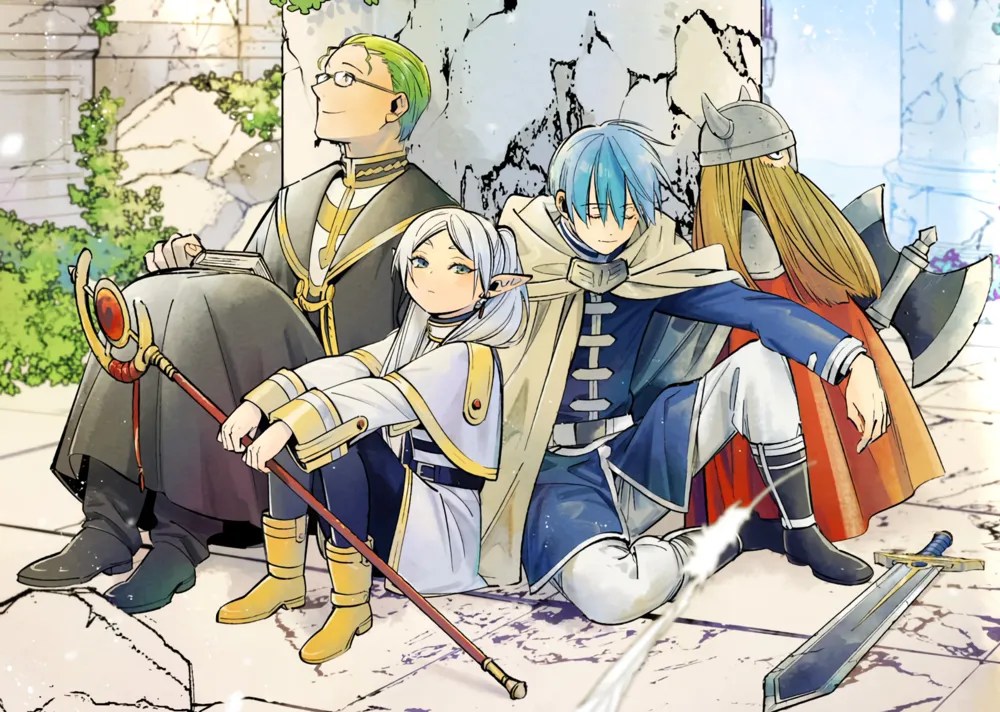
Frieren: Beyond Journey’s End – Shogakukan.
For a bit more context, Frieren was a member of the party that defeated the Demon King 50 years before the bulk of the series’ plot takes place. With the world saved, the great evil vanquished, and their quest complete, the four heroes go their separate ways and promise to reunite to witness the meteor shower that recurs every 50 years.
While her companions go onto the basically live out their entire lives in the interim, Frieren herself basically experiences the ensuing 50 years how a Human would treat a couple months. Shortly after reuniting, Himmel, the leader of the party – with an apparently-unrequited crush on Frieren – dies of old age.
The loss of her friend (and possible love interest), and especially the realisation that she never bothered to get to know him very well despite travelling together for years, affects Frieren deeply. In fact, Himmel’s death is one of the few things in the series that causes Frieren to openly cry and convinces her to be more open and honest with others and try to connect with other people more earnestly.
The “present day” of the series, so to speak, picks up with Frieren’s two remaining companions, the priest Heiter — who also promptly dies of old age —and the Dwarf warrior Eisen — who, as a Dwarf, has a longer lifespan than the Humans, but probably still isn’t long for this world, either (especially not compared to Frieren), tasking Frieren to look after their apprentices.
It’s a bit of a “Time is a Flat Circle“/”It’s Like Poetry, It Rhymes” thing: one journey ends, another journey begins. Frieren sets off with Heiter’s apprentice Fern (a mage) and Eisen’s apprentice Stark (a warrior). And although their adventure is taking place against the backdrop of the demon armies previously vanquished by Frieren’s original party resurging, Frieren isn’t really on a quest to save the world.
The quest is Frieren’s journey to essentially process her grief in both a metaphorical and literal manner. Frieren, Fern, and Stark are setting off to find the magical region where the souls of the dead are said to gather so she can meet Himmel one more time.
As you can probably tell, Frieren is a very melancholic and bittersweet series. In fact, part of me is terrified that the last shot of the series is going to be everyone Frieren loves dying again, and Frieren wanders off into the sunset again.
There are moments of genuine peril and high stakes in the series, but for the most part, the series is primarily Frieren, Fern, and Stark moving from town to town and getting into various side-quests – and the occasional major quest that takes up a multi-episode story arc.
It’s not necessarily dark, though the Demons are pretty disturbing and some of the violence they inflict is pretty graphic.
Essentially, the Demons aren’t necessarily evil and certainly not mindlessly so. But their morality and psychology is so alien and incomprehensible compared to how Humans see the world. Demons don’t really have emotions of their own, Demon society is based on strength and dominance (sort of like Tolkien Orcs, or… really most variants of Orcs, actually) and doesn’t have concepts like compassion, altruism, empathy, or even family.
Most simply, the Demons aren’t necessarily Immoral but are certainly Amoral in a way that makes them ruthless and horrifying. They aren’t evil, they’re just wrong.
A lot like traditional folklore Elves, actually…
In fact, there’s a pretty interesting contrast between Frieren’s psyche and the Demons’. I’ll be discussing that more in-depth in my second post.
Two of the clearest demonstrations of the Demons’ psyche is a conversation between two demon characters about their lack of understanding of why dying Humans cry for their parents or why a father would want to avenge the death of his son, and a flashback where a Demon girl wipes out a family so she can give the family’s daughter to a couple who lost their own daughter.
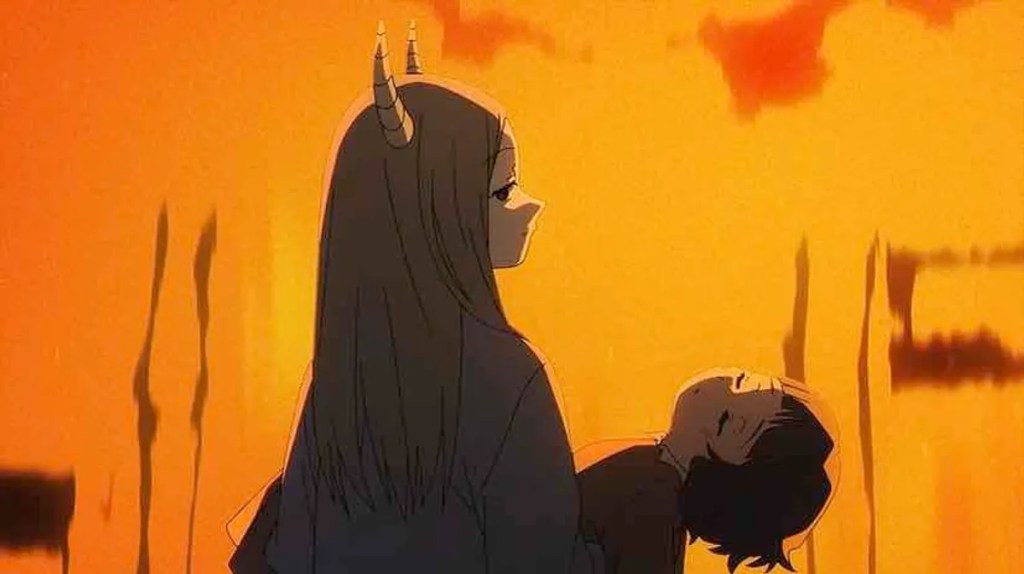
And, like, going off pure, cold logical the math behind that makes sense. But the Demon only sees the transactional, mathematical calculation “They don’t have a daughter, that family has an extra daughter, now they have a daughter” and none of the moral, psychological, or social reasons why that’s an absolutely horrifying way to solve things.
On the flipside, the best demonstration of how Humans work in the Frieren-verse is Frieren’s battle with the Demon Qual. 80 years ago, Qual was so powerful and such a threat that even Frieren herself could only seal him away. In the present, the seal is beginning to fail and Qual’s re-emergence is at first presented as a major calamity and the viewer is probably expecting an intense, major fight scene.
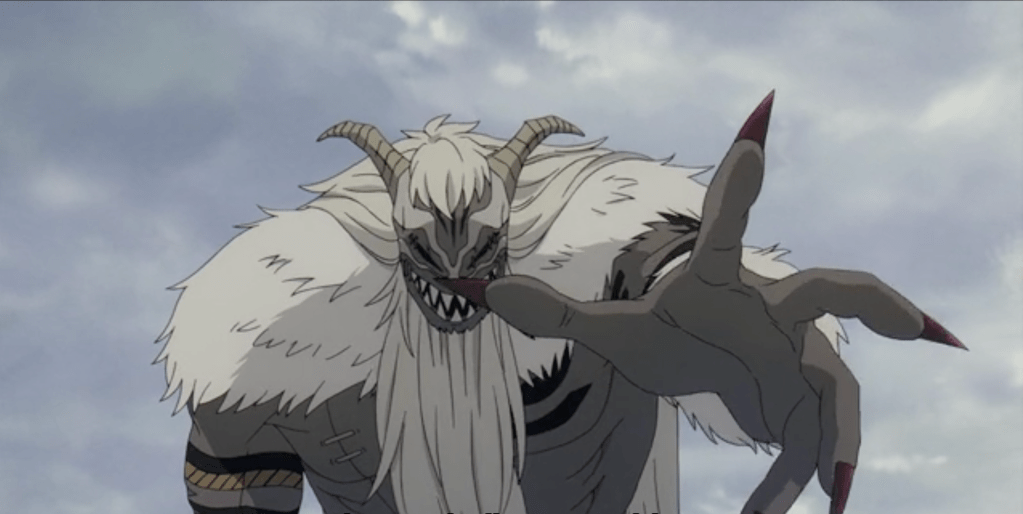
Frieren: Beyond Journey’s End – Madhouse.
What we get is a one-sided drubbing.
With Qual on the receiving end.
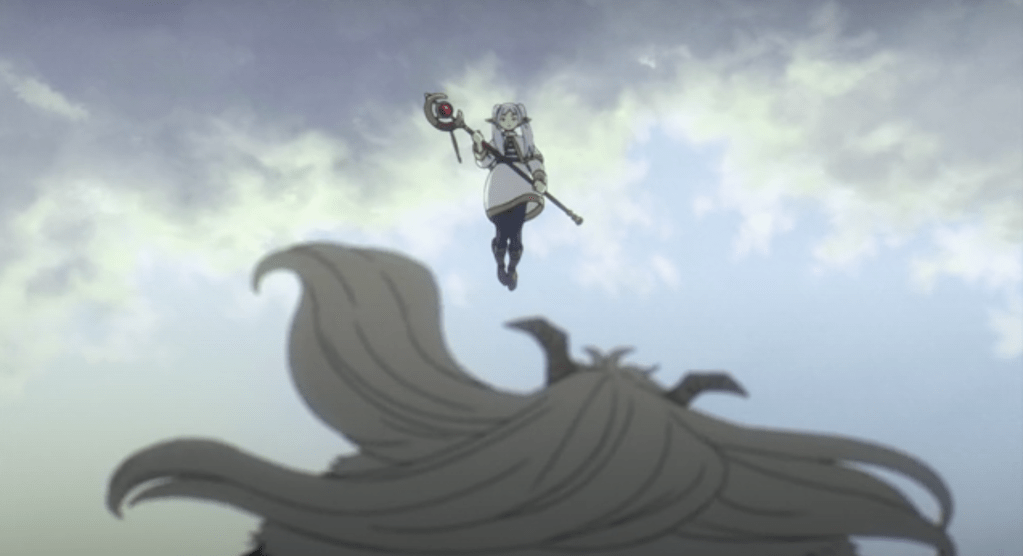
Frieren: Beyond Journey’s End – Madhouse.
In the intervening 80 years, the Human mages studied and analysed Qual’s signature magic, developing countermeasures and incorporating his spells into their own corpus of magic, to the point that the spell that rendered Qual all but unstoppable 80 years ago is now considered basic, entry-level magic.
By the time Qual reawakens, even an apprentice like Fern is able to tank his attacks, while Frieren blows him away with his own spell.
Humans are short-lived but inquisitive and industrious, something that impresses even Frieren.
If I have one primary issue with Frieren, it’s that I had more fun binge-watching the first season after it had finished airing than I did watching the second season one episode a time — I was a late-comer to the first season but got hooked to the point of eagerly awaiting the second season to watch the episodes as soon as possible.
Frieren has the same pacing – “problem” isn’t the right word – qualities that a lot of anime series do, where each cour or season or just span of episodes covers a story arc, meaning that while that stretch of episodes does move the plot along and resolve the story arc by the end, each individual episode doesn’t move it forward that much.
Though, again, that’s not a Frieren problem. That’s an episodic TV problem…
Now, maybe I’m admittedly just buying into the hype from the services trying to get me to sign up to watch the series, but I do think we’ve been really lucky to get some anime series in recent seasons that have made some really impressive production values. Just off the top of my head Delicious in Dungeon, Spy x Family, Dan da Dan, and the Mononoke movies have all really impressed me with how well their art style, animation, music, and VO (in the original Japanese and English dubs) have come together for really memorable viewing experiences.
Incidentally, except a Mononoke post soon. It’s one of my favourite anime series ever and the movies are probably the best Mononoke we’ve gotten so far…
Frieren is another recent anime that’s really impressed me from a production standpoint.
The art is great, the character designs are great – especially the various monsters and the more inhuman-looking demons like Qual. I’m not enough of an expert to do a deep dive or pick apart the animation, but I never noticed anything that looked like an issue.
The soundtrack is phenomenal and is probably one of the best Fantasy soundtracks I’ve heard in a while. The casting and VO performances are great in both Japanese and English (with Crunchyroll also providing dubs in about 10 other languages.
Frieren in particular is great in both languages. Japanese VO Atsumi Tanezaki plays her as bit more youthful, better capturing the fact that he’s still physically young despite having live for centuries, whereas English VO Mallorie Rodack plays her as more mature and less outwardly emotive, better capturing the fact that she’s lived for centuries despite her outwardly youthful appearance.
Essentially, it’s two sides of the same coin: Frieren is still young and youthful for an Elf, but she’s lived for centuries and has become one of the most accomplished and learned characters in the setting.
On lark and given the Germanic, Holy Roman Empire influence on the series’ worldbuilding, I watched a bit in German, too. Granted, I don’t speak German, so I can’t actually evaluate how good it actually is, but I liked the tone and delivery Fern’s German voice was using.
Notably, the end sequence of the second season was hand-drawn with pencil crayons and traditionally animated frame-by-frame. Even beyond the fact that’s an impressive amount of work and commitment, it has a wistful, Fairy Tale quality that really vibes with the, um, vibes of the series as a whole.
Of particular note in terms of the character art and animation are the various funny faces Frieren makes when she’s either being weird or deliberately trolling the other character. Of particular note to that particular note are how Frieren is portrayed when she’s sleeping. Despite being a genius and one of the most powerful characters in the setting, her sleep habits leave her utterly graceless and undignified and ending up either upside-down, or sideways, or out of her bed.
Or all of those things.
Which I relate to on a deep spiritual level.
It’s not for nothing that Frieren is my favourite autistic Elf not written by me…
More on that soon.
Luckily, Frieren is a pretty easy anime to watch. It’s currently streaming on both Crunchyroll and Netflix – dependent, of course, on geographical region. Though, as of this writing, only the first season is currently available on Netflix. The third season of the anime is currently slated for the fall of 2027.
The original manga series has been on indefinite hiatus since last fall.
Now, a quick reminder that I am a professional writer and editor, and if you’re in need of writing and editing support, please consider taking a look at the work and rates currently offered by Emona Literary Services™ and reach out if you think I can help you.
Please consider supporting Emona Literary Services™ to help me expanding my publishing and content creation projects, via Patreon, Ko-fi, or directly through Paypal by scanning the QR code below:

You can follow me on my various social media platforms here:
© Joel Balkovec — Published by Emona Literary Services™.

This work is licensed under a Creative Commons Attribution-NonCommercial-NoDerivatives 4.0 International License.
The author prohibits the use of content published on this website for the purposes of training Artificial Intelligence technologies, including but not limited to Large Language Models, without express written permission.
All stories published on this website are works of fiction. Characters are products of the author’s imagination and do not represent any individual, living or dead.
View the Emona Literary Services™ Privacy Policy here.


Leave a Reply