
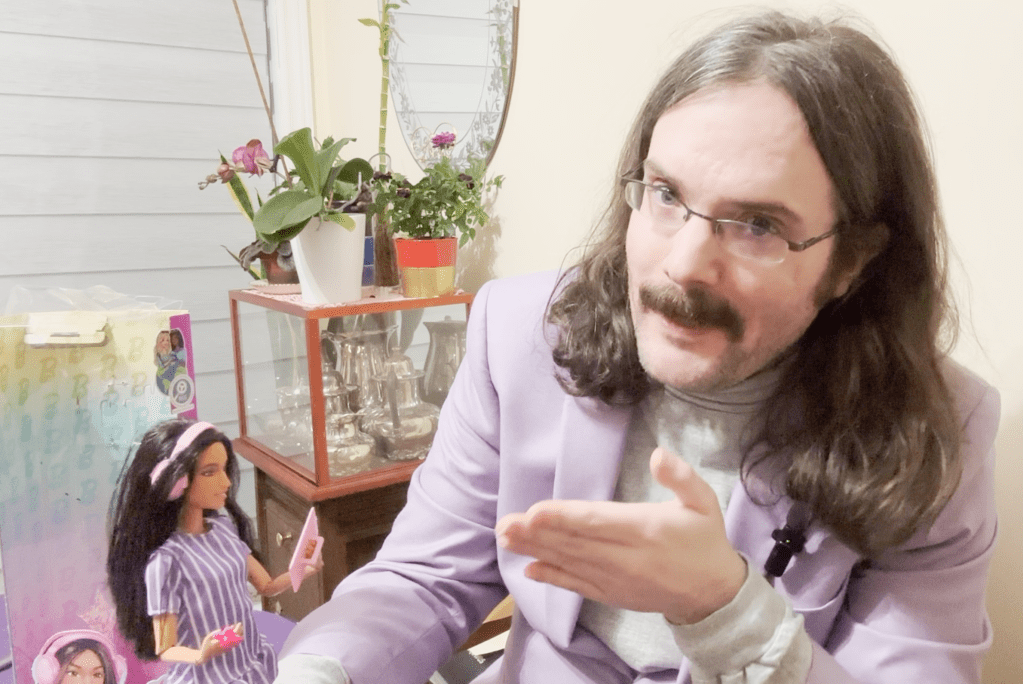
I just posted my first ever unboxing video, and at the expensive of spoiling the answer to “What’s in the Box, Joel?”, the thing I’m unboxing is the new Autistic Barbie doll.
The bulk of my thoughts – some of which are actually about the Barbie and most of which seem to actually be more broadly about autistic representation – are in the video itself:
But, also, there are a few more things I’ve realised in hindsight after I finished filming that I think are worth fleshing out a bit more: Specifically, that I don’t it matters what Autistic Barbie is supposed to be like.
Thinking more about the ‘Kids will play with/interpret their toys in ways the makers didn’t anticipate’ angle, and how it ties into the criticism that Autistic Barbie is bad because she’s not 100% of everyone’s experience with autism, I have seen both some absolutely braindead takes about the whole thing. Perhaps not coincidentally from neurotypicals — FYI: FYI: if there’s one thing autistic people absolutely love, it’s being told how to feel about their own lived experience by neurotypicals…
I’ve also seen some much better-articulated takes from other autistic people that I sympathise with but don’t really agree with for the reasons I will enumerate below.
Again, it comes back to the idea that the fact that Autistic Barbie has a communications device, implying that she’s non-verbal – which does reflect my own misgivings that she’s perhaps reinforcing the idea of ‘Autistic = Severely Disabled.’
There’s a but coming…
But, Mattel can’t force kids to play with Autistic Barbie in any one specific way, and because Autistic Barbie is essentially a blank slate whose only personality comes from the kids playing with her. She’s got headphones and a tablet, but there’s no hard rule that those need to be assistive tech because of her autism.
Wait a minute…
Headphones and a tablet?
She could be a DJ.
You know what? As far as I’m concerned, she is a DJ.
What?
As much as I hate the Death of the Author principle, I think it applies here. Mattel can only design and build the doll, every kid playing with a Barbie, autistic or otherwise, is going to be playing her with an entirely unique perspective on who exactly she is.
Briefly, if you’re unfamiliar with the Death of the Author, quoth Wikipedia:
“The Death of the Author” (French: La mort de l’auteur) is a 1967 essay by the French literary critic and theorist Roland Barthes (1915–1980), which spawned a literary theory of the same name. Barthes’ essay argues against traditional literary criticism‘s practice of relying on the intentions and biography of an author to definitively explain the “ultimate meaning” of a text. Instead, the essay emphasizes the primacy of each individual reader’s interpretation of the work over any “definitive” meaning intended by the author, a process in which subtle or unnoticed characteristics may be drawn out for new insight.
Fundamentally, there’s no reason why kids can’t play with Autistic Barbie has a talented, happy, successful DJ. Or social worker. Or teacher. Or author
Or, you know, anything.
Because – yes, we may have difficulties that neurotypicals don’t face, and those difficulties can be substantial – there’s no rule that real autistic people can’t be talented, happy, or successful.
That’s an important lesson, and despite some of the criticisms I’ve seen about Autistic Barbie, I do actually think she can be valuable in teaching kids that lesson.
So, that’s my second write-up for Autism Awareness month. Incidentally, you can read what I consider my masterpiece of commentary on autism in Pop Culture – itself reflecting on a masterpiece of autistic representation in Pop Culture here:
Now, a quick reminder that I am a professional writer and editor, and if you’re in need of writing and editing support, please consider taking a look at the work and rates currently offered by Emona Literary Services™ and reach out if you think I can help you.
Please consider supporting Emona Literary Services™ to help me expanding my publishing and content creation projects, via Patreon, Ko-fi, or directly through Paypal by scanning the QR code below:
You can follow me on my various social media platforms here:
© Joel Balkovec — Published by Emona Literary Services™.

This work is licensed under a Creative Commons Attribution-NonCommercial-NoDerivatives 4.0 International License.
The author prohibits the use of content published on this website for the purposes of training Artificial Intelligence technologies, including but not limited to Large Language Models, without express written permission.
All stories published on this website are works of fiction. Characters are products of the author’s imagination and do not represent any individual, living or dead.
View the Emona Literary Services™ Privacy Policy here.
 Emona Literary Services
Leave a comment