

Rune Factory: Marvelous and Xseed Games.
The tagline for for Rune Factory 5 was “Fight. Farm. Fall in love.” and the game’s publisher Marvelous clearly knows that a big chunk of the fanbase is especially interested in that “Fall in love” part. As seen, for example, by the Marvelous’ decision to hype up the release of spin-off game Guardians of Azuma by focusing on the romanceable bachelors and bachelorettes.
Long story short: they’re all babes…
Still, “Fight. Farm. Fall in love.” is a pretty good way to sum up the series.
Part 1: Everything Up to Guardians of Azuma
Originally published as a spin-off of the series which was known at the time as Harvest Moon – and is currently known as Story of Seasons, Rune Factory is now pretty solidly consolidated into its own series with minimal overlap to the original series beyond the farming and life sim aspects, and, in fact, has put out several spinoffs of its own. As of this writing, the most recent and noteworthy is the Fantasy-Japan–themed Guardians of Azuma.
Circling back to the “now known as Story of Seasons” thing, the short recap of the situation is: the series of which Rune Factory is a spinoff has always been called Bokujō Monogatari — it means something like “Farm (or Ranch) Story “— in Japan. It was originally localised as Harvest Moon, until the developer (which has itself changed several times thanks to various buyouts and mergers) changed publishers in North America. The previous publisher retained the rights to the “Harvest Moon” name and essentially started its own series of farming games under the old name.
It’s sort of like how WWE tried (poorly) to continue using the Razor Ramon and Diesel characters after Scott Hall and Kevin Nash went to WCW.
Conversely, the actual continuation of the series formerly called Harvest Moon is now localised as Story of Seasons.
And, again, the Japanese name has always been Bokujō Monogatari.
It’s all fairly convoluted and not particularly important to the discussion of Rune Factory. But, hey, now you know.

And perhaps further complicated by the fact that Harvest Moon is also a Neil Young album…

All of which is to say, the first Rune Factory was tied into the original series to the point that it was literally subtitled “A Fantasy Harvest Moon” – a connection that has since largely been dropped.
At the expense of coming across as a pretentious Japanophile, I’m going to refer to the original series as “Bokujō Monogatari“ for the rest of this post. I swear it’s not a “the original Japanese version is better; I order all my video games direct from Akihabara“ thing; it’s purely because it creates the least amount of confusion while referring to the original series.
I have played every game in the series to some degree, but the only ones I’ve played to a meaningful extent are 4 and 5. Out of necessity, I’ll be focusing most on those two. If you’re interested in a deeper dive into the other games in the series, you can find that information easily enough the Internet elsewhere.
In brief: Rune Factory 1 is a decent game, but a little rough around the edges, 2 is an improvement on 1, 3 is generally regarded as when the series got good, Frontier is 1.5 in terms of world and story and is the first fully 3D game in the series, Oceans (variably called Tides of Destiny depending on market) is also a full 3D game and has one of my favourite casts in the series but the dungeons were a slog, 4 is probably the best game in the series mechanically and was the last game before the original developer went bankrupt, leading to a nine-year hiatus between releases.
Incidentally, I, uh, I literally started crying tears of joy when they first announced Rune Factory 5…
My Little Pony: Friendship is Magic: Habsro Studios.
…and subsequently again when they announced Guardians of Azuma.
Since release, Rune Factory 5 has caught a lot of flak on the Internet, but I’ve personally enjoyed it, and as of this writing, have played through it about twice-and-a-half.
The biggest complaint are the technical aspects, specifically the frame rate and the animations. And, yeah, they’re there, but they’re not significant enough to really bother me.
Now, that all being said, I think they’ve patched in improvements. My first and most recent playthroughs were months apart, and the second time around, it seems like it’s running better and smoother. Though it’s entirely possible I’m mis-remembering what it was like in the early days…
Honestly, I think I liked 5 more than 4, which is going to be a near-blasphemous statement to most of the fanbase.
For one thing, the re-release of 4 didn’t really handle being ported from a handheld to a home console (which is, of course, also usable as a handheld…) very well. 5 have may technical issues, but at least it feels like it was designed as a console game — as good as the art direction and character design is, it gets more chances to shine in full 3D than the isometric style of the portable games.
Though, mechanically, it didn’t quite stick the landing in terms of transitioning to full 3D. Incidentally, Oceans didn’t quite, either, but I wouldn’t be surprised if most of 5‘s issues are the result of being the work of a new developer.
More substantially, though, way too much of 4 was dependent on completely random events that the player had minimal ways of actually influencing and mostly just involved waiting around for the RNG to cut you a break.
Incidentally, we’re sort of in a golden age for Rune Factory right now. Especially considering the original developer went bankrupt.
5 has proven popular, with the fanbase warming up to it as time goes on — if not beloved. As of Fall 2022, a new Rune Factory is in development, though I’ve read that it’s going to be a spinoff rather than a next number entry. 4 got re-released on Switch, as did 3, there’s talk of 1 and 2 getting re-releases.
And even other developers are putting out games that really owe a debt to the Rune Factory concept. For example, Square Enix’s — “Squenix,” if you will — Harvestella:
Incidentally, I have played Harvestella. It’s less of a straight-up Farming Sim than it was promoted as and kinda ends up feeling like a more actiony Final Fantasy game with several Rune Factory aspects that ends up being less good than either Final Fantasy or Rune Factory…
Also, the story’s kind of a nonsensical mess that makes a really weird swerve into full-on Sci Fi. Now, that shouldn’t be considered a spoiler — it’s not so much a twist as it is the first major plot beat. The spoiler is exact implications of that really weird swerve into full-on Sci Fi.
Though, honestly, I should have been able to see that coming. The “stella” is right there in the title…
Although Rune Factory is very much a JRPG and have become more story-driven as the series has progressed, it’s never entirely discarded its origin as a Bokujō Monogatari spinoff. And whereas Bokujō Monogatari is a farming game, Rune Factory is an RPG with a prominent farming subsystem.
You don’t necessarily progress the game by farming, but the farming is your most stable source of both income and skill/stat improvement, especially in the early game.
It’s not necessarily the main point of the game, but it’s important enough that you can’t really play a Rune Factory game without also farming.
Incidentally, it does sort of tie into the lore of the games. The majority of playable characters in the series are something called an Earthmate.
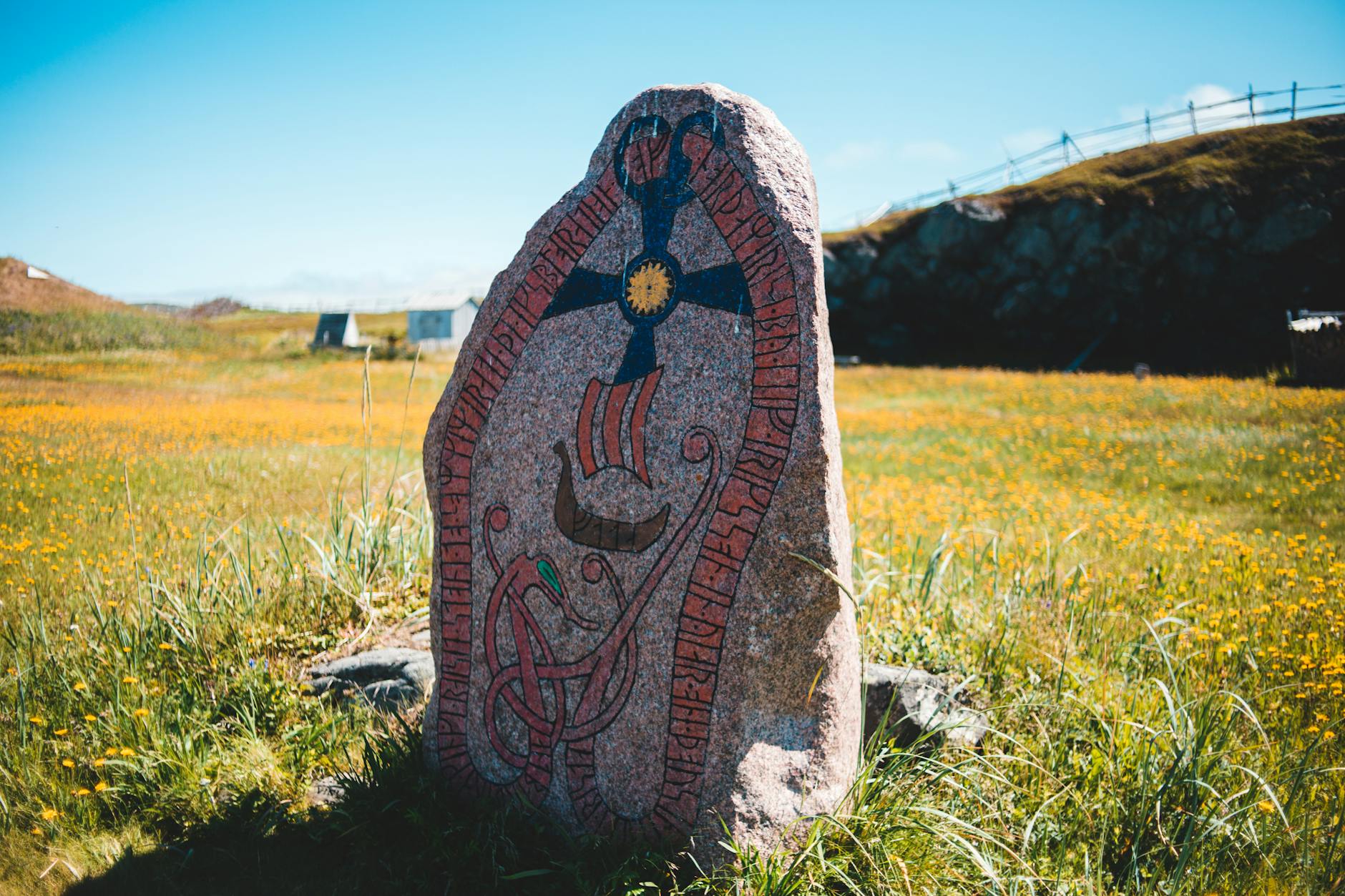
Really, it’s exactly what it sounds like: basically a person with a special connection to the earth and a unique ability to utilise the magic that keeps the natural world in balance — the runes that I’m assuming are the reason the series is called Rune Factory…
So, there is ultimately a plot-relevant reason why you’re farming.
The stories of the Rune Factory games have never been great, but they’ve always been serviceable.
Usually, it boils down somebody or something disrupting the balance of the runes and it’s up to you to stop it and restore the balance. The series has had an ongoing story around the conflict between the Sechs Empire and the Kingdom of Norad (which doesn’t have an article of the wiki), and although the Empire is usually the bad guys, most of the geopolitical details and implications of the conflict are consigned to the background.
You’ll be making your way through a series of dungeons that tend to cleave to recurring themes and settings. Both Rune Factory 4 and 5, for example have a Forest dungeon, a Lava dungeon, and a Vaguely Gothic Horror-themed dungeon (5 actually has a couple).
Mechanically, the gameplay is pretty simple but well-executed for what it is. At the baseline difficulty, the games — at least as of 4 (the oldest game in the series I can still remember in details) — aren’t particularly difficult and it’s very easy to become over-levelled relative to your progress through the story.
My one complaint in regards to difficulty isn’t even about the difficult itself, it’s that a lot of the bosses in 4 had way too much health/defence and took forever to beat. A problem, incidentally, largely solved in 5. On the other hand, 5 runs into the opposite problem, with a couple of exceptions, even most of the bosses can feel like pushovers if you’ve been working on levelling up.
Also, it’s way too easy to get your hands on a weapon that’s hilariously overpowered and can take out even most of the bosses in a couple hits. As of 5, if you give characters five handmade gifts in one day, they’ll reciprocate by giving a gift in return.
These gifts are related to what the character in question: the doctor gives you potions, the flower shop lady gives you flowers, the apprentice blacksmith gives you forging material, the actual blacksmith gives you weapons.
Now, what exactly they’re giving you is random and there’s no ceiling to the level of stuff they give you, so it’s entirely possible they’ll be giving you stuff completely out of proportion to your progress in the game, meaning it can be ludicrously easy to make a whole bunch of money in a short time or end up with a weapon that will absolutely wreck everything right up to the endgame.
You also can’t really die in Rune Factory as of 3 (again, 4 is where my clear memories the series start, so don’t quote me on that). There are a couple places in 4 where you do die if you run out of health, but it’s not a major threat at those points. Most of the time, you just wake up in the given game’s town clinic with slightly lighter pockets.
It makes sense. Rune Factory is a pretty laid-back, low-stakes, low-pressure series aimed at a youngish audience. There are some legitimately emotionally powerful scenes and the games do touch on heavy themes like loss and mortality. For the most part, though, it’s at about the level of a typical Disney movie and has a pretty Realmgard-ian sense of humour and one gets the sense that the localisation team had a lot of fun with their jobs.
Now, maybe a script full of memes and Pop Culture references won’t appeal to everyone, but I think it’s enjoyable. For example, during the Harvest Festival, you can hype up your potato by noting you can “boil ‘em, mash ‘em, stick ‘em in the stew“…ish. I working from memory here and I don’t remember if it’s the full, actual Lord of the Rings quote, or just a paraphrase. But it is clearly a reference.
Part 2: Guardians of Azuma
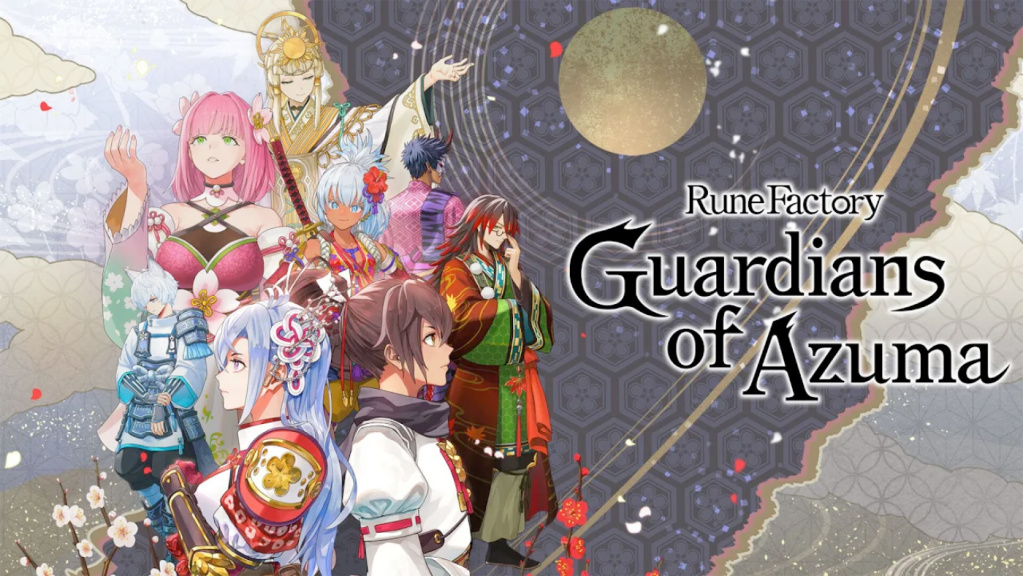
It becomes pretty clearly apparent that Guardians of Azuma isn’t a typical Rune Factory Game. The most noticeable difference is that it’s set in the titular Japan-influenced country of Azuma, rather than the series’ typical generically Fantasy-y continent of Adonea – the existence of Azuma had previously been established in previous games by the presence of characters with Japanese names and aesthetics, but this is the first time we’ve ever seen Azuma in any detail, or that it even got a proper name.
The central premise of the game is that, 50 years ago, Azuma suffered something called the Celestial Collapse, which literally broke up the land, including creating an entire archipelago of floating islands in the sky and dramatically upset the balance of Azuma’s Rune magic.
Your character is an Earth Dancer, essentially Azuma’s equivalent of the Earthmates from the rest of the series, working with a dragon god to restore the Runes to Azuma, largely by means of reawakening Azuma’s seasonal and elemental gods who sealed themselves away after the Celestial Collapse.
Naturally, they go on to become villagers and marriage candidates.
Whereas the rest of the series is focused on farming, Guardians of Azuma is more focused on town building and management. You’re in charge of four villages corresponding to the four season and, as you start restoring Azuma, people start returning to the villages. Your villagers can be assigned to automatically take care of the farming, mining, forestry, and fishing, meaning that your primary duty is to actually build up the villages.
The farming become fundamentally automated and self-sufficient also means that Guardians of Azuma is more action and combat-centric than the typical Rune Factory game. Fundamentally, it’s an action RPG that happens to have a town management component, rather than a Farming Game that’s also an action RPG.
While it’s probably a little harder to be ludicrously over-levelled and overpowered in Guardians of Azuma, it’s still not a terribly difficult game that could probably serve as a pretty decent “My First RPG” for either younger gamers or players without much experience.
The combat is simple – especially compared to other action RPGs with broadly similar gameplay like The Witcher, Veilguard, or especiallyespecially the Souls games or Elden Ring – but competent and probably the best-executed of any of the 3D Rune Factory games.
The general consensus in the fanbase is that Rune Factory 4 is still the best game in the series, but I think Guardians of Azuma is my favourite. Simplifying and automating the farming makes that aspect of the game easier and a little less arcane than it has been before. There are less unexplained factors behind growing high-level crops, which a plus for someone who doesn’t really have the patience for them.
Guardians of Azuma certainly looks and runs better than 5 did. I have yet to play the Switch 2 version, so I can’t speak to how different the performance is, but I never noticed any major issues on the OG Switch.
Guardians of Azuma isn’t quite fully voice-acted, but, as far as I can tell, it has the most extensive voice acting of any game in the series, with basically everything but the characters’ most generic, repeatable lines being voice acted and animated.
I like the characters, but in terms of their personalities and designs. Admittedly, those personalities are pretty simple, with most of the characters really only having one or two defining character traits that dominate their interactions, but that’s true of the cast in most Rune Factory games and even just true of the characters in a lot of video games.
Overall, I think how much you enjoy Guardians of Azuma is going to depend on how committed to the established Rune Factory gameplay you are.
Now, a quick reminder that I am a professional writer and editor, and if you’re in need of writing and editing support, please consider taking a look at the work and rates currently offered by Emona Literary Services™ and reach out if you think I can help you.
Please consider supporting Emona Literary Services™ to help me expanding my publishing and content creation projects, via Patreon, Ko-fi, or directly through Paypal by scanning the QR code below:

You can follow me on my various social media platforms here:
© Joel Balkovec — Published by Emona Literary Services™.

This work is licensed under a Creative Commons Attribution-NonCommercial-NoDerivatives 4.0 International License.
The author prohibits the use of content published on this website for the purposes of training Artificial Intelligence technologies, including but not limited to Large Language Models, without express written permission.
All stories published on this website are works of fiction. Characters are products of the author’s imagination and do not represent any individual, living or dead.
View the Emona Literary Services™ Privacy Policy here.
 Emona Literary Services
Leave a comment